

Audio Overview
According to a recent report by Gartner, nearly 60% of marketing leaders report that their teams lack the necessary skills to execute their strategy effectively in an increasingly complex digital landscape [1]. This gap between strategic ambition and operational reality often forces organizations into a reactive cycle, where they manage vendors on a task-by-task basis rather than partnering with experts who drive business outcomes.
Goose Digital is changing this dynamic by moving beyond the traditional agency-client relationship. By positioning the agency as a fractional Chief Marketing Officer (CMO), Goose Digital provides the strategic oversight, technological expertise, and executional horsepower required to bridge the gap between high-level goals and measurable growth. This approach—rooted in Intelligent Marketing—integrates strategy, automation, artificial intelligence, and human creativity to ensure every marketing dollar contributes to a stronger pipeline.
The Evolution of Partnership
For many businesses, the traditional agency model is broken. It often relies on “order-taking,” where the client identifies a need and the agency executes it in a silo. This reactive method frequently leads to disjointed campaigns and missed opportunities for scaling.
A major shift for Goose Digital was moving from reactive order-taking to proactive account mapping, which ensures the agency acts as an indispensable partner in its clients’ growth. This transition means the agency is no longer just a service provider; it is a strategic extension of the client’s team. Whether a client is an “Extend” customer—those with internal marketing leaders who need specialized support—or a “Transform” customer—those who rely on Goose Digital to build and lead their entire marketing department—the objective remains the same: driving business performance rather than just completing tasks.
Leading with Strategy: The Quarterly Review
The cornerstone of the fractional CMO model is the Retainer Strategy Session, often referred to as a Quarterly Business Review (QBR). In a traditional vendor relationship, strategy is often a one-time event at the beginning of a contract. At Goose Digital, strategy is a living process.
Every retainer customer participates in a dedicated strategy session each quarter. These sessions are designed to ensure the delivery plan remains perfectly aligned with shifting business objectives. During these reviews, a senior Strategist and the Account Leader evaluate the previous quarter’s performance and adjust the “Strategy Brief.” This document serves as the North Star for the engagement, outlining the marketing plan, strategic objectives, and specific considerations for creative and technical attribution.
By involving a senior Strategist—a leader with years of experience in the field—Goose Digital ensures that the client isn’t just “doing marketing” but is following a documented path toward marketing maturity. This proactive alignment prevents the “drift” that often occurs when teams become too focused on day-to-day execution and lose sight of the overarching business goals.
The Monthly Planner: Managing Expectations and Tasks
If the Quarterly Business Review sets the direction, the Monthly Planner is the engine that drives the vehicle. One of the most common frustrations in marketing partnerships is a lack of visibility into how time and budget are being utilized.
Goose Digital addresses this through a rigorous monthly planning process. All activities performed for a customer are blocked out into a detailed planner that includes categories, specific tasks, and time estimates. This planner serves three primary functions:
- Transparency: The client sees exactly what is being worked on and how it aligns with the quarterly strategy.
- Efficiency: By pre-planning the month’s activities, the team avoids the gross inefficiencies of last-minute, reactive requests that often yield lower-quality results.
- Accountability: It allows the Account Lead to manage the “Time, Cost, and Quality” triangle effectively, ensuring that deliverables are never rushed at the expense of performance.
This level of organization is critical for managing the “Ladder of Growth.” Customers are only willing to expand their marketing programs when they see a consistent history of strategic alignment, quality execution, and, ultimately, real business performance.
The Marketing Performance Model
To operate as a fractional CMO, an agency must have a framework for testing and scaling ideas. Goose Digital utilizes the Marketing Performance Model to classify every campaign into one of four phases:
- Ideation: Identifying new opportunities and sketching out marketing concepts.
- Testing: Moving approved concepts into a phase where assumptions are tested to determine if further investment is warranted.
- Proving: Optimizing the results over a longer period to validate the opportunity for scaling.
- Run Rate: Operationalizing the winning solutions to reduce the cost per result and monitor ongoing performance.
This model ensures that the client’s budget is protected. Instead of pouring resources into unproven tactics, the agency follows a disciplined path of validation. This is the hallmark of an intelligent marketing operation: making data-driven decisions that prioritize ROI over “gut feelings.”
Roles of Leadership: Strategist vs. Account Leader
The fractional CMO model relies on a clear division of labor between two key roles: the Strategist and the Account Leader.
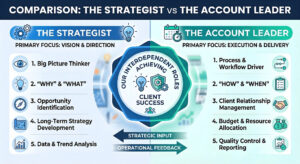
The Strategist is a senior leader responsible for aligning the agency’s services with the customer’s needs. They look at the “big picture,” focusing on market positioning, audience segmentation, and the long-term roadmap. They are brought back into the conversation whenever the current strategy needs to pivot or when a client introduces net-new initiatives.
The Account Leader is the primary point of contact and the person responsible for executing the Strategy Brief. They are the “billable resource” who leads the delivery team, manages the monthly planner, and ensures that the quality of work remains high. They act as the “V-formation” lead, guiding both the agency’s internal team and the client through the complexities of digital marketing.
FAQ: Fractional CMO & Account Management
What is the difference between an Account Leader and a Strategist?
The Strategist focuses on the high-level “why” and “what” of the marketing program, creating the Strategy Brief. The Account Leader focuses on the “how” and “when,” managing the day-to-day execution, timelines, and communication to ensure the strategy is realized.
How often do we review the overarching marketing strategy?
At a minimum, strategy is reviewed during the quarterly Retainer Strategy Sessions. However, if a strategy isn’t delivering results fast enough or if the customer’s business pivots, a Strategist is engaged immediately to refresh the approach.
What happens if we need to make a last-minute request?
Goose Digital strives to manage all work through the Monthly Planner to maintain quality. However, for immediate needs, retainer customers generally have a 1–3 day turnaround time. These are accommodated as long as they do not negatively impact the team’s ability to deliver on existing commitments.
How do you keep track of all our tasks and wish-list items?
All tasks, action items from meetings, and future “wish-list” ideas are captured and maintained in a centralized task management platform (Notion). This list is reviewed regularly with the client to ensure nothing is missed and priorities remain clear.
How do you handle scope changes or overages?
In-scope work is explicitly defined in the Statement of Work (SOW). If a new opportunity arises that exceeds 20% of the retainer hours or requires specialized services, the Account Lead will engage the Strategist or Sales team to determine if a Change Request or a new SOW is required. This ensures that the quality of the core retainer work is never compromised.
The Key Takeaway
Operating as a fractional CMO means taking full accountability for a client’s marketing success. It requires a shift from doing tasks to driving outcomes. By combining quarterly strategic rigor with monthly operational discipline, Goose Digital helps organizations cross the “chasm of marketing maturity” and build scalable, revenue-focused programs. When an agency and a client move in the same direction with a shared strategy, they don’t just complete projects—they achieve measurable business growth.
Here’s a time from us to you. Schedule a standing “Strategy Refresher” on your calendar for the first week of every quarter to move your focus away from the “to-do list” and back toward your primary business objectives for the year.
Sources
-
Gartner. (2023). Gartner marketing survey finds 58% of CMOs report their teams lack the capabilities needed to deliver on their strategy. https://www.gartner.com/en/newsroom/press-releases/2023-05-22-gartner-marketing-survey-finds-58-percent-of-cmos-report-their-teams-lack-the-capabilities-needed-to-deliver-on-their-strategy
-
Content Marketing Institute. (2024). B2B content marketing insights. https://contentmarketinginstitute.com/
-
HubSpot. (2024). The state of marketing report. https://www.hubspot.com/state-of-marketing
-
Goose Digital. (2025, April). Migrator’s handbook. https://goosedigital.com/content-hub/
Content Integrity
This article was generated with the assistance of AI and edited by a human team member.