
Audio Overview
Your most valuable marketing data isn’t in your marketing platform.
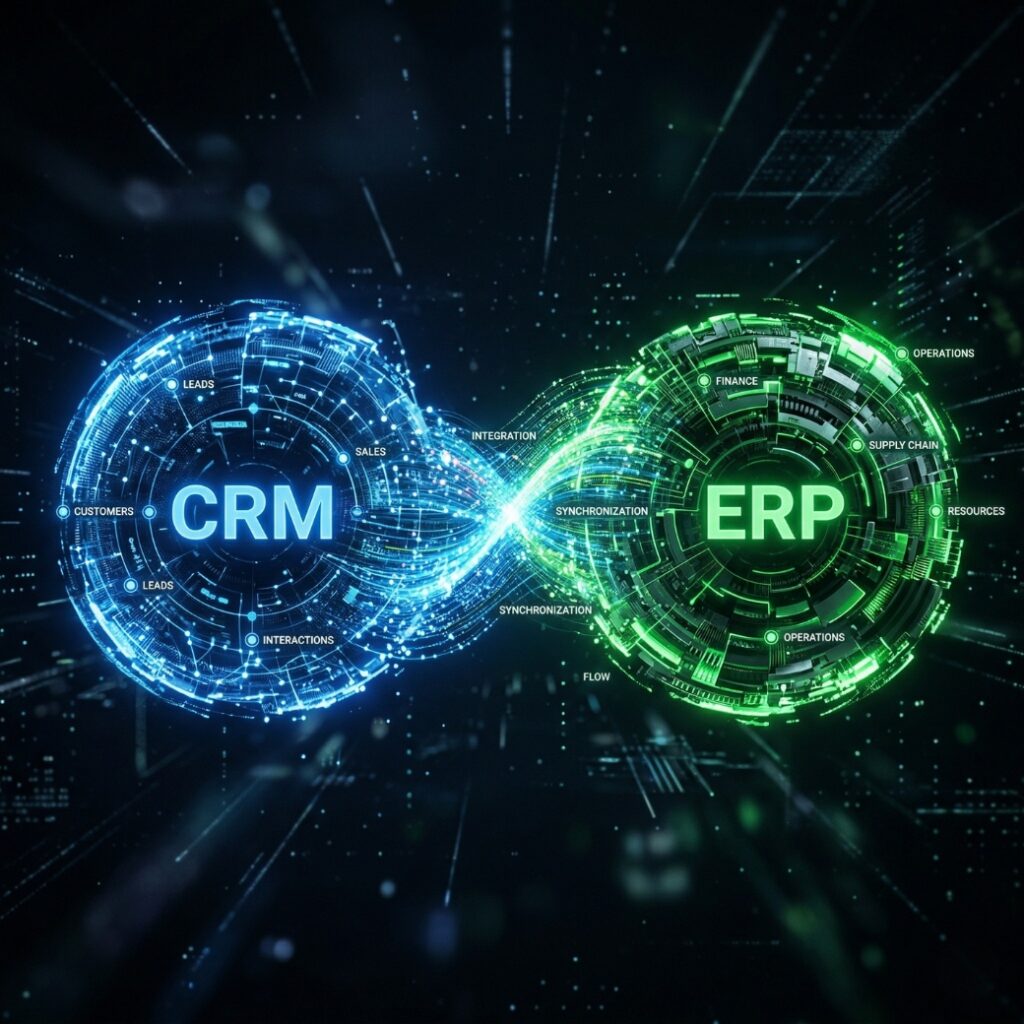
For many manufacturers and distributors, this statement is a frustrating reality. The most powerful insights—customer purchase history, order frequency, inventory levels, and shipping details—are locked away in an Enterprise Resource Planning (ERP) system, the operational brain of the business. Meanwhile, the sales and marketing teams operate from a Customer Relationship Management (CRM) platform, the hub for customer interaction. The gap between these two worlds is more than an inconvenience; it’s a significant bottleneck that stifles growth, creates inefficiency, and leads to a disconnected customer experience.
The competitive landscape in Canadian manufacturing is no longer defined by who has the most data, but by who can act on it the fastest. Closing the gap between your ERP and CRM is the single most critical step toward turning operational data into a strategic asset. By connecting these systems, organizations can stop guessing and start building intelligent, automated marketing programs that drive real revenue.
The High Cost of a Disconnected View
When your ERP and CRM systems don’t communicate, they create data silos—isolated islands of information that prevent anyone from seeing the complete customer picture. This disconnect creates tangible problems that impact teams across the entire organization. A recent study found that data silos remain a challenge for a staggering 90% of businesses, making it a nearly universal operational drag. [1]
For manufacturers, the consequences are particularly acute:
- Ineffective Sales Efforts: A salesperson preparing for a client call has to toggle between the CRM and a separate ERP portal (or call the accounting department) to check on recent orders or payment status. They enter conversations lacking critical context, which can weaken relationships and lead to missed opportunities for upselling or cross-selling.
- Impersonal and Irrelevant Marketing: Without access to purchase history, your marketing team is flying blind. They might send a promotional email for a piece of equipment a customer just purchased last month or fail to notify a client that the consumable parts they regularly order are back in stock. This generic approach erodes customer trust and results in wasted marketing spend.
- A Fractured Customer Experience: A customer calling for support on a recent order has to repeat their order number and purchase date because the service agent’s CRM screen doesn’t show ERP data. These small points of friction add up, making your company feel disorganized and difficult to do business with.
- Hidden Growth Opportunities: Your ERP knows which customers are due for equipment servicing, which ones have a buying pattern that suggests a future upgrade, and which products are frequently purchased together. Without a connection to the CRM, these data-driven signals for proactive outreach are lost.
A Practical Framework for Connecting the Dots
Solving the integration bottleneck doesn’t require a complete overhaul of your technology stack. It requires a strategic, phased approach focused on connecting the most valuable data points first to achieve immediate wins.
Step 1: Define Your Business Goals
Before writing a single line of code or buying new software, ask what specific business problem you are trying to solve. Technology is a tool, not the goal itself. Clear objectives provide a roadmap for the entire project.
Examples of strong business goals include:
- “We need to automate renewal reminders for service contracts 60 days before expiration.”
- “Our sales team must see real-time inventory levels for key products directly within the CRM.”
- “We want to create a ‘top 25 customers’ marketing segment based on lifetime purchase value, which is tracked in the ERP.”
Step 2: Map the Critical Data Flow
Not all data needs to be synchronized. A common mistake is attempting to boil the ocean by syncing every single field. Instead, focus on the information that provides the most value to your marketing, sales, and service teams.
- Data to move from ERP to CRM: Customer contact details, sales order history, invoice and payment status, product shipment updates, and current inventory levels.
- Data to move from CRM to ERP: New customer account information (after a deal is closed), updated contact details from sales interactions.
Start with a small, high-impact data set, like order history. Proving the value of this single integration will build momentum and internal support for future phases.
Step 3: Choose the Right Integration Method
Once you know what data needs to move, you can select the best technical path to connect the systems.

- Native Connectors: Many modern CRM and ERP platforms (like Salesforce, HubSpot, and Microsoft Dynamics) offer pre-built integrations. These are often the simplest and most reliable options.
- Middleware Platforms: Tools known as Integration Platform as a Service (iPaaS), such as Zapier or n8n, act as a bridge between applications. They are excellent for connecting multiple systems or when a native connector isn’t available.
- Custom API Development: For highly customized or older legacy systems, a custom-built integration using Application Programming Interfaces (APIs) may be necessary. While this offers the most flexibility, it requires specialized development resources.
For many organizations, the challenge lies in older or non-standard ERPs that lack modern connectors. This is a common hurdle. Goose Digital has experience across many ERPs, including legacy systems or those that aren’t considered “mainstream.” This expertise allows our customers to navigate these technical complexities in a way that drives to quick wins, often using a combination of middleware and targeted API work without requiring a full system overhaul.
The Payoff: Powering Intelligent Marketing and Sales
With a seamless flow of data between your ERP and CRM, you unlock the foundation for Goose Digital’s Intelligent Marketing approach—where strategy, automation, and AI converge to produce measurable results.
- Hyper-Personalized Automation: You can now build marketing campaigns that are impossible with siloed data. Trigger a follow-up email with training resources after a product is marked “shipped” in the ERP. Send a re-order reminder to customers based on their typical purchase cycle. Create targeted campaigns for customers who have bought Product A but not the complementary Product B.
- An Empowered and Efficient Sales Team: Your sales representatives can now operate from a single screen. Within the CRM, they have a 360-degree view of the customer—every marketing interaction, every sales call, every order, and every payment. This empowers them to have smarter conversations, identify upsell opportunities instantly, and act as true strategic advisors to their clients.
- A Single Source of Truth: Finally, your business can align around one unified view of the customer. This enables accurate revenue attribution, a clear understanding of customer lifetime value, and the ability to identify your most profitable customer segments with confidence. This clean, connected data is also the essential fuel for future artificial intelligence initiatives that can predict customer churn or optimize pricing.
Stop Managing Systems, Start Driving Growth
The disconnect between your operational and customer-facing platforms is more than a technical issue; it’s a direct barrier to growth. Continuing to operate with fragmented data means leaving revenue on the table, forcing your teams into inefficient workflows, and delivering a customer experience that falls short of expectations. In today’s market, that’s a risk manufacturers and distributors can no longer afford.
By strategically integrating your ERP and CRM, you bridge the gap between business operations and customer engagement. This is the core of Intelligent Marketing—using technology and data to create scalable, measurable, and revenue-focused outcomes. It transforms your rich operational data from a passive, siloed record into an active, powerful asset that fuels growth.
Sources
- MuleSoft. (2022). 2022 connectivity benchmark report. https://www.mulesoft.com/lp/reports/connectivity-benchmark
Content Integrity
This article was generated with the assistance of AI and edited by a human team member.