

Audio Overview
Is Your Marketing Technology Creating More Work Than It Solves?
Organizations face a critical challenge: the proliferation of marketing technology platforms often creates more complexity than it resolves. When companies prioritize novelty over discipline, they accumulate “process debt”—the inefficiency caused by fragmented workflows, redundant tools, and a lack of mastery over the existing systems. This debt slows down campaign execution, muddies data accuracy, and distracts marketing teams from high-level strategic thinking.
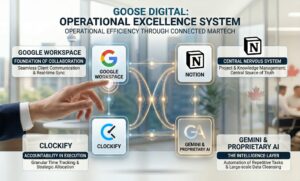
At Goose Digital, we address this challenge by adhering to a philosophy of discipline over novelty. We focus on a concentrated core technology stack—Google Workspace, Gemini, Notion, and Clockify—to eliminate administrative friction. By mastering these tools, we ensure that every minute billed is focused on driving business outcomes rather than navigating technical hurdles.
The Hidden Cost of Process Debt
Process debt occurs when an organization’s internal workflows become so cumbersome that they hinder the very goals they were designed to support. According to research by Gartner, nearly 60% of marketing leaders report that their technology stacks are too complex, leading to underutilization of expensive platforms [1]. When a team is forced to jump between disparate tools for communication, task management, and data analysis, the switching cost erodes productivity and increases the likelihood of human error.
To avoid this, Goose Digital employs a lean, integrated ecosystem. We do not adopt new tools because they are trending; we adopt them only if they demonstrably improve our ability to deliver Intelligent Marketing—our signature approach that blends strategy, automation, Artificial Intelligence (AI), and human creativity. By maintaining a limited but powerful tech stack, our Account Leaders can focus on the Marketing Performance Model: moving campaigns from ideation and testing into proving and scalable run rates.
Mastering the Core Stack
Our operational efficiency is built upon four primary pillars. Each tool serves a specific purpose in ensuring transparency, collaboration, and data-driven execution.
1. Google Workspace: The Foundation of Collaboration
Google Workspace serves as our central hub for communication and document creation. Because most modern businesses utilize this environment, it allows for seamless collaboration between Goose Digital and our clients. Whether we are drafting a Strategy Brief or building complex data models in Google Sheets, the focus is on real-time synchronization. This reduces the need for long email chains and ensures that the most current version of a document is always accessible to all stakeholders.
2. Notion: The Central Nervous System
Notion is where Goose Digital captures institutional knowledge and manages complex projects. Every customer engagement is logged here, creating a single source of truth for every task, meeting note, and campaign brief. This centralized approach is vital for maintaining the standards outlined in our Migrator’s Handbook—our internal guide for Account Leadership. By moving action items from meetings directly into the Notion task management area, we ensure that nothing is missed and that clients have full visibility into the progress of their programs.
3. Clockify: Transparency in Execution
Accountability is a cornerstone of our value proposition. We utilize Clockify to track the time spent on every account with granular precision. This data is not just for billing; it is a strategic tool. By analyzing time allocation, we can identify if a project is experiencing “overages”—where we are investing more time than estimated—which allows us to pivot quickly or right-size the retainer to ensure the client is getting the best possible return on investment.
4. Gemini and Proprietary AI: The Intelligence Layer
While many agencies are still figuring out how to use Artificial Intelligence, we have moved past the experimental phase. We use Gemini, Google’s advanced AI model, to automate the mundane aspects of marketing operations. This includes summarizing meeting transcripts, generating initial drafts for content, and performing large-scale data cleansing.
For the second consecutive year, executing our AI strategy meant developing proprietary AI-powered tools to streamline workflows. By building our own applications on top of existing Application Programming Interfaces (APIs)—the sets of rules that allow different software to communicate—we have created a workflow where AI handles repetitive heavy lifting. This frees up our human experts to focus on the storytelling and strategic insights that drive brand resonance.
Operationalizing AI to Free the Mind
The goal of our AI-powered stack is not to replace human expertise but to amplify it. McKinsey & Company research suggests that generative AI could automate work activities that absorb 60% to 70% of employees’ time today [2]. At Goose Digital, we capitalize on this by shifting our focus from manual execution to high-level strategy.
When AI manages the “fit and finish” of a campaign—such as checking for technical errors or optimizing send times for emails—our strategists can spend more time on the business outcome. For a “Goose Transform” customer, this might mean analyzing how a digital campaign is impacting their overall revenue pipeline. For a “Goose Extend” customer, it might mean finding new ways to integrate their Customer Relationship Management (CRM) system with their marketing automation platform to create a more personalized customer journey.
Security and Quality in an AI World
A common concern with the adoption of AI is the security of customer data. We address this through a rigorous Information Security policy. All files are stored within our secure Google Drive and Notion environments, never on local computers.
To ensure the highest standards of integrity, we have established an AI Acceptable Use Policy (AI-AUP). This policy clearly outlines to our team and our customers exactly how we use AI and the specific rules we follow to protect intellectual property. We use enterprise-grade environments that do not use client information to train public models. This ensures we reap the efficiency gains of automation without ever compromising the confidentiality of your data.
FAQ: AI & Tech Stack
How is Goose Digital using Gemini and AI to improve efficiency?
We use Gemini to automate repetitive administrative and technical tasks. This includes drafting campaign briefs, analyzing large datasets for trends, and generating meeting summaries. By automating these tasks, we accelerate the delivery of high-value strategy and creative work.
Does Goose Digital have a formal policy for AI usage?
Yes. We maintain a comprehensive AI Acceptable Use Policy (AI-AUP) that governs how our team interacts with these technologies. This policy ensures that AI is used responsibly, ethically, and securely across all client engagements. You can review the full policy at https://goosedigital.com/ai-use-policy/.
Does your use of AI compromise the quality or security of our work?
No. Every AI-generated output is reviewed and refined by a human expert to ensure it aligns with your brand’s voice and strategic goals. Regarding security, we use enterprise-level AI tools that adhere to strict data privacy standards, ensuring your information is never shared or used to train external models.
Why do you focus on a limited core tech stack?
A limited stack ensures mastery. When our team is highly proficient in a few powerful tools, they spend less time troubleshooting software and more time executing your strategy. This minimizes process debt and maximizes the value of every hour we work.
How do you track the time spent on our account?
We use Clockify to log every minute spent on client tasks. This data is reviewed regularly by Account Leads and managers to ensure we are staying within the estimated scope and delivering work efficiently.
What is process debt and how do you avoid it?
Process debt is the accumulation of inefficient workflows caused by using too many tools or having poorly defined procedures. We avoid it by centralizing all communication and project management in Notion and Google Workspace, and by using AI to eliminate manual, time-consuming steps in our operations.
Summary of Key Takeaways
The modern marketing landscape is cluttered with tools that promise efficiency but often deliver distraction. Goose Digital’s commitment to discipline over novelty ensures that our technology stack serves the strategy, not the other way around. By mastering a core set of tools and operationalizing AI under a strict Acceptable Use Policy, we eliminate process debt and focus our efforts on measurable growth.
Our Advantage
Organizations choose Goose Digital because we bring together the right platforms, processes, and people to create marketing programs that are scalable, measurable, and revenue-focused.
Sources
[1] Gartner, “Gartner Survey Finds Marketing Leaders Struggle to Maximize Martech Stack Value,” 2023. [2] McKinsey & Company, “The Economic Potential of Generative AI: The Next Productivity Frontier,” 2023.Content Integrity
This article was generated with the assistance of AI and edited by a human team member.