
Audio Overview
Key Takeaways
- Early Architecture Prevents Breakdown: Implementing a foundational Customer Relationship Management (CRM) system and Marketing Automation Platform (MAP) early prevents operational bottlenecks as lead volume grows.
- Speed-to-Lead Drives Conversions: Automated lead capture, scoring, and instant follow-up ensure prospects receive immediate attention, improving conversion rates without increasing headcount.
- Minimum Viable Automation Focuses on High Impact: Lean teams achieve maximum efficiency by prioritizing core workflows: initial welcome sequences, qualification triggers, and lifecycle stage updates.
- Artificial Intelligence (AI) Accelerates Execution: Utilizing AI for segmentation, message variation, and campaign testing reduces wasted spend and shortens campaign launch cycles.
- Clean Data Enables Investor Trust: Standardized contact fields and attribution modelling deliver reliable reporting for executive leadership and prospective investors.
Research from The Oracle reveals that organizations implementing automated marketing workflows experience up to a 451% increase in qualified leads compared to manual processes.
For lean startup teams, manual customer acquisition causes delayed follow-ups and lost revenue. Marketing automation bridges this gap, allowing small teams to accelerate speed-to-lead and drive growth without expanding headcount.
Building the Foundation: Tech Stack Decisions and Core Setup
Establishing marketing operational readiness requires selecting software tools that fit immediate needs while supporting future expansion. Startups frequently err by accumulating disconnected tools or over-investing in complex enterprise suites before establishing core processes.
A startup technology stack relies on four elements: a Customer Relationship Management (CRM) system, a Marketing Automation Platform (MAP), web analytics, and revenue attribution tracking. Connecting tools through native integrations or custom Application Programming Interface (API) webhooks syncs prospect activities across systems. Advanced setups use automated reverse-waterfall lead enrichment via API to append company size and industry metrics before sales engagement.
Establishing explicit lifecycle stages (Subscriber, Lead, Marketing Qualified Lead, Sales Qualified Lead, Opportunity, Customer) prevents premature outreach. Strict data hygiene; such as field standardization and deduplication workflows; ensures reliable investor metrics. A four-person firm in the commercial services space was essentially managing customer records and prospects in spreadsheets before coming to Goose Digital for help. They became one of our clients, and we began implementing a centralized CRM platform with automated workflows can reduce manual data entry and administrative waiting time, enabling sales and customer service staff to re-invest those hours into higher-value pipeline activities. Teams seeking to expand operational capabilities can review how AI automation helps high-growth companies scale marketing without expanding headcount.

Minimum Viable Automation: Core Workflows for Lean Teams
Rather than automating every touchpoint, lean teams should implement a Minimum Viable Automation framework targeting high-impact, repeatable processes.
First, automate lead routing and confirmation. When a prospect requests product details, an automated email delivers resources instantly with a direct scheduling link, while internal webhooks alert sales channels on platforms like Slack or Microsoft Teams to enforce response Service Level Agreements (SLAs).
Second, deploy automated lead scoring. Assigning points to demographic data and engagement behavior allows the platform to calculate buyer intent continuously. Incorporating score decay; such as subtracting points after 14 days of inactivity; maintains data accuracy before triggering sales alerts.
Third, establish automated lead nurture sequences. Nurture programs deliver educational content over several weeks using content-affinity branching: if a prospect views technical documentation, subsequent messages highlight security features. To optimize these workflows, teams can examine 4 ways to implement marketing automation data to systematically convert campaign metrics into program adjustments.
Accelerating Execution with Artificial Intelligence
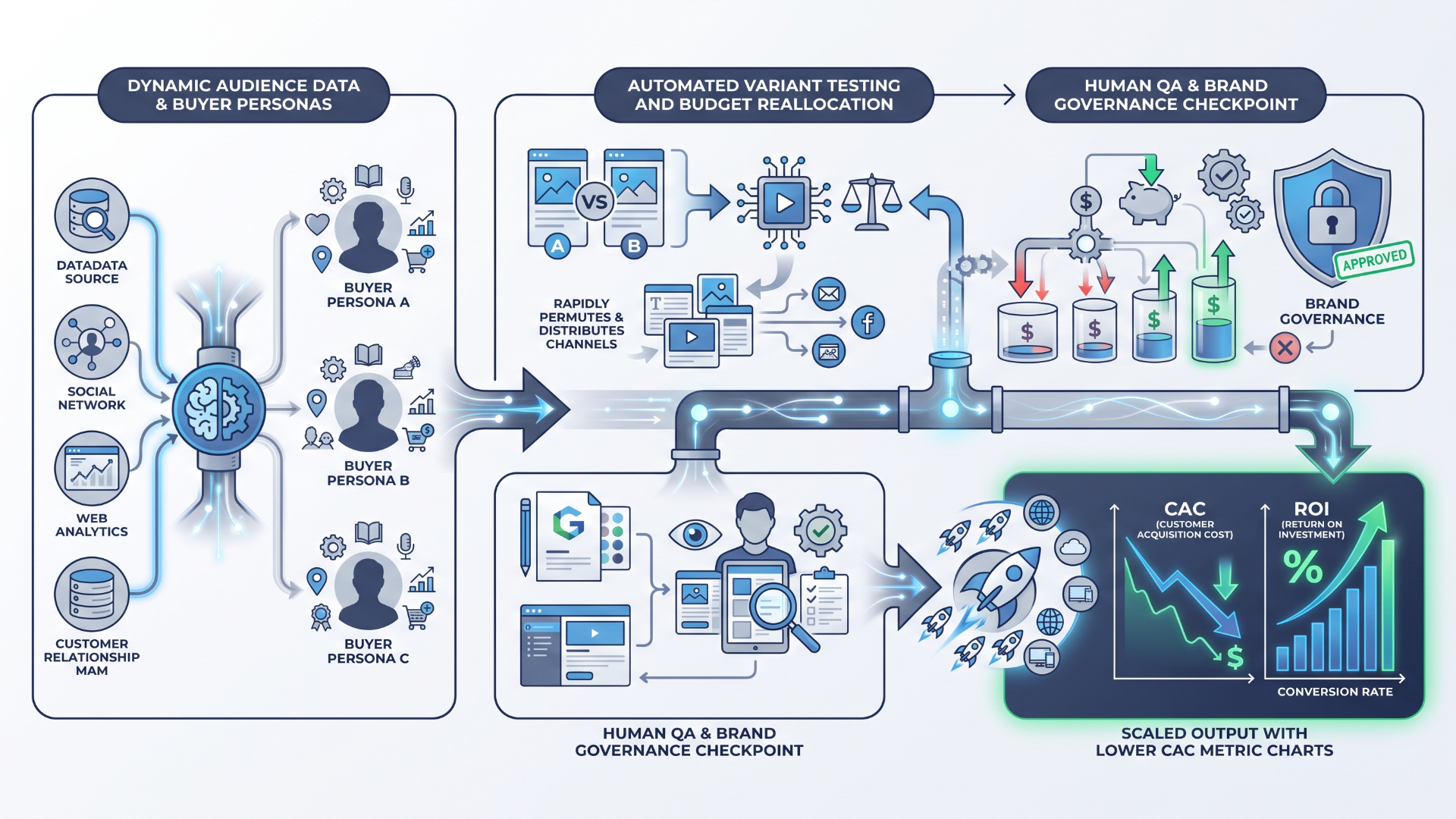
AI serves as an execution multiplier for lean teams. Rather than producing generic content, high-performing startups apply AI to streamline operations, lower Customer Acquisition Cost (CAC), and sharpen targeting.
AI capabilities update customer lists dynamically based on behavior and personalize messaging for specific buyer personas. In paid digital campaigns, AI enables rapid testing of copy and subject lines, reallocating budget toward top-performing variants automatically.
Maintaining clear AI governance frameworks with human Quality Assurance (QA) oversight ensures brand consistency while scaling operations. To explore how to align strategic data initiatives across your organization, read a blueprint for growth activating your data to drive measurable results.
Summary of Key Takeaways and Next Steps
Implementing essential marketing automation enables startups to maximize resource efficiency, lower CAC, and build scalable growth engines. By deploying scalable system architecture early, focusing on high-impact workflows, maintaining strict data hygiene, and applying AI with human QA oversight, lean teams can maximize performance without overextending resources.
Evaluating your marketing automation strategy is the first step toward scalable revenue growth. Contact us at Goose Digital to assess your current technology stack, build tailored automation workflows, and execute performance marketing strategies that drive measurable outcomes.
Sources
Content Integrity
This article was generated with the assistance of AI and edited by a human team member.