Accredited Webinar Versions Coming to Your Province Soon!
The Way People Search for Insurance Is Changing
For years, search marketing was relatively straightforward. A customer needed insurance. They opened Google, typed something like “commercial insurance near me”, “best home insurance company”, or “business insurance quote”, reviewed a handful of search results, and clicked through to a website.
That behaviour still exists, but it is no longer the only way people find answers.
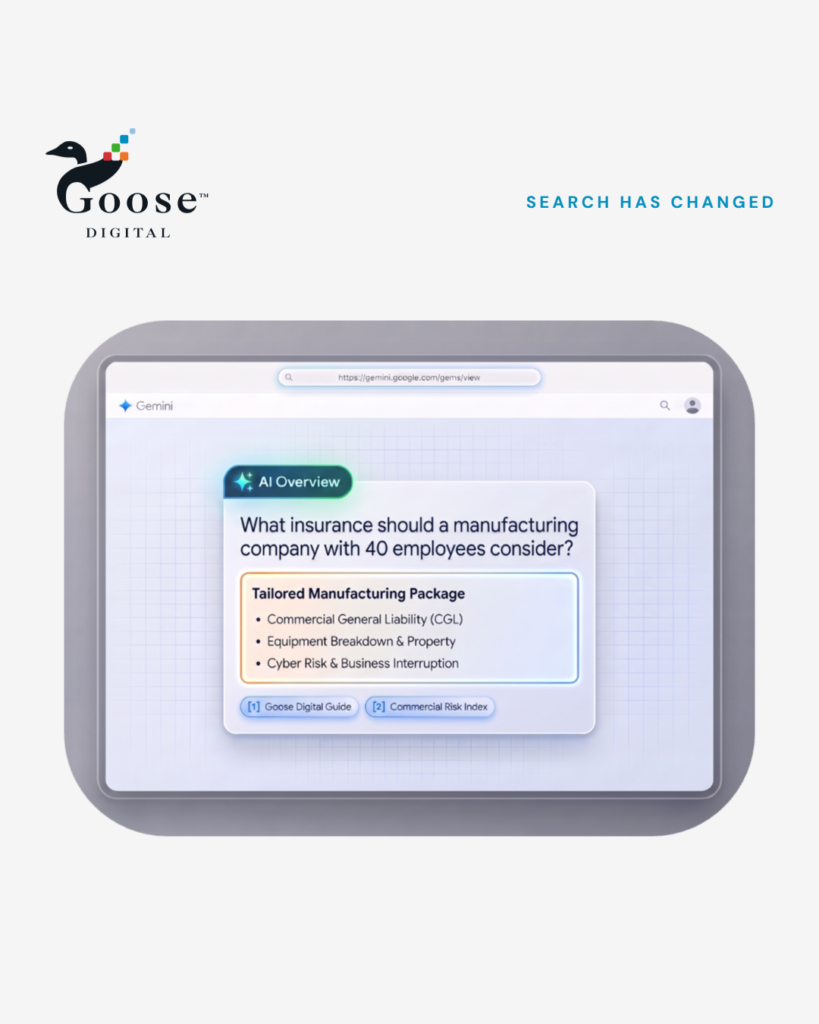
Today, consumers and commercial buyers are increasingly asking complete questions through Google AI Overviews, ChatGPT, Perplexity, and other AI-powered search experiences.
Instead of searching for “commercial insurance broker”, they may ask:
- “What insurance should a manufacturing company with 40 employees consider?”
- “Does my home insurance cover sewer backup after a major storm?”
- “What insurance does a technology company operating in Canada and the United States need?”
The search engine is no longer simply being asked to find a webpage—it is being asked to provide the answer.
That shift has important implications for insurers, brokerages, agencies, MGAs, and other insurance providers. The fundamentals of search have not disappeared; in many ways, they have become even more important. However, organizations now need to think beyond Traditional SEO and begin considering Answer Engine Optimization (AEO) as part of their broader digital strategy.
What Is Answer Engine Optimization in Insurance?
Answer Engine Optimization (AEO) is the practice of structuring and publishing content so search engines and AI platforms can easily understand, retrieve, and use it when answering a user’s question.
Traditional SEO typically focuses on helping a webpage rank for a keyword. AEO goes one step further by asking: Can a search engine clearly understand what this organization knows, what services it provides, where it operates, and whether the information can be trusted enough to use in an answer?
For insurance organizations, that means creating content around real customer questions rather than simply publishing pages designed around individual keywords. A strong commercial insurance page, for example, shouldn’t only target “commercial insurance.” It should also answer questions such as:
- What types of commercial insurance does my business need?
- What does commercial general liability insurance cover?
- What isn’t typically covered?
- How does coverage change as my business grows?
- What factors affect commercial insurance premiums?
- When should I speak with an insurance professional?
This is where SEO and AEO begin working together:
- SEO helps search engines find and understand the page.
- AEO helps search and AI platforms extract useful answers from it.
Although search interfaces are changing, quality content, reputation, local and entity verification, and clear expertise remain foundational.
Insurance Has a Higher Trust Hurdle Than Many Industries
Insurance is not like selling shoes, furniture, or consumer electronics. The information people find online can influence significant financial decisions, business continuity, asset protection, and personal security.
Google generally treats financial topics as part of what it calls YMYL (Your Money or Your Life)—subjects where inaccurate or misleading information could have a meaningful impact on someone’s financial stability, health, safety, or well-being.
That makes trust particularly important for insurance content. Publishing hundreds of generic AI-generated articles is therefore not a meaningful AEO strategy. Insurance organizations need to demonstrate that there are real people, real expertise, and real experience behind the information being published.
E-E-A-T: Experience, Expertise, Authoritativeness, and Trustworthiness
Google’s E-E-A-T framework provides a useful way to think about the quality signals surrounding insurance content:
- Experience: Show that your organization understands the situations customers actually face. This could include anonymized claims examples, coverage scenarios, real customer questions, industry-specific risk examples, and practical explanations from experienced professionals.
- Expertise: Make the expertise behind the content visible. Include author biographies, professional designations, licensing information where appropriate, areas of specialization, and relevant industry experience.
- Authoritativeness: Authority is not created entirely on your own website. Industry associations, media mentions, conference appearances, podcasts, educational content, community organizations, and other credible third-party references all help establish who your organization is and what it is known for.
- Trustworthiness: Insurance websites also need the basics right. Clear contact information, accurate service information, secure websites, privacy policies, accessible disclaimers, current licensing information, and authentic reviews all contribute to overall trust.
Your Website Is No Longer Your Entire Search Strategy
One of the biggest changes in modern search is that your website is only one source of information about your brand. Search engines and AI systems can encounter your organization through many different digital environments.
Your search footprint increasingly includes:
- Your website
- Google Business Profile
- Reviews and testimonials
- LinkedIn and social media channels
- YouTube
- Industry publications and directories
- Third-party mentions
This multi-channel entity authority means search engines use discussions, videos, third-party reviews, and external brand signals alongside your website. You do not need completely different ideas for every channel; instead, one strong piece of expertise can become many useful search signals.
For example, a commercial insurance specialist answering “What insurance does a growing construction company need?” could turn that single insight into:
- A detailed website article
- A two-minute YouTube explanation
- Several LinkedIn posts
- An FAQ section
- A sales-enablement resource
- An email newsletter snippet
- A webinar discussion point
- An answer to a relevant community question
The expertise already exists inside most insurance organizations—the opportunity lies in translating that expertise into formats customers and search platforms can actually access.
Insurance Needs to Bring Its Offline Expertise Online
Insurance professionals answer complex questions every day—explaining exclusions, identifying coverage gaps, translating endorsements, helping businesses understand changing risks, and explaining why two seemingly similar policies provide vastly different protection.
A large portion of that expertise still happens behind closed doors via phone calls, meetings, renewal conversations, and emails. However, today’s customer begins their search online. Insurance Providers have an opportunity—and arguably a responsibility—to bring more of that expertise into the digital experience.
The objective should not simply be: How quickly can we generate a lead? It should be: How well can we help someone understand the decision they are about to make? Trust built during the research process creates more informed buyers and shortens the distance to a meaningful sales conversation.
Build Content Around Real Insurance Questions
The days of publishing a generic 300-word article simply because a keyword appeared on a content calendar are fading. Modern insurance content must resolve meaningful questions.
A recommended content structure:
- Start with the question: Write headings the way someone might actually ask the question. Instead of “Commercial Property Coverage Considerations”, use “What does commercial property insurance typically cover?”
- Answer it immediately: Provide a direct, concise response right under the heading.
- Elaborate: Follow the direct answer with detailed explanations, real-world examples, regional risks, and exceptions.
This natural-language structure serves human readers while making information seamless for search and AI systems to interpret.
Local Content Still Matters, Even in an AI Search World
For insurance organizations with local offices, regional distribution networks, or geographically specific products, local search remains vital. Insurance is inherently regional—coverage availability, regulation, catastrophic risks, construction trends, and consumer needs vary significantly across:
- Provinces and states
- Cities and municipalities
- Industry sectors
- Climate zones
- Regulatory jurisdictions
Instead of publishing generic articles like “What is home insurance?”, create localized resources addressing specific risks:
- “How should homeowners in hurricane-prone regions think about wind coverage?”
- “What should businesses operating in wildfire regions consider when reviewing property insurance?”
- “How can severe hail affect commercial property insurance?”
For local offices, maintain accuracy across technical foundations: your Google Business Profile, business name, address, phone number, service details, and directory listings must remain consistent.
Structured Data Helps Machines Understand Your Organization
AEO isn’t only about writing; there is a technical component as well. Schema markup is structured data added to a website that explicitly tells search engines what a page or organization represents.
Depending on your site, structured data helps identify:
- Organization details and locations
- Geographic service areas
- People, authors, and credentials
- Products and services offered
- FAQ sections and articles
- Customer reviews and contact information
Schema will not make weak content authoritative on its own. However, combined with strong content, clear site architecture, and credible expertise, it makes your information exponentially easier for machines to index and summarize.
Before Chasing AI Visibility, Fix Your Digital Foundation
There is a temptation to jump directly into AI optimization, but AEO cannot compensate for a website that is fundamentally broken. Before worrying about whether ChatGPT can find your organization, ensure Google and your customers can navigate your website effectively.
Start with these essential fundamentals:
- Establish priority search terms and map them to appropriate pages and URLs.
- Optimize page titles, headings, copy, metadata, and internal links.
- Fix broken links, broken forms, and 404 errors.
- Update outdated team, location, and product information.
- Ensure the website is secure (HTTPS) and compliant with privacy and regulatory standards.
- Improve mobile usability, page-load speeds, and image compression.
- Verify that Analytics, Conversion Forms, and Call-Tracking Tools Function Properly.
- Build clear author and expert profiles.
A Practical 90-Day SEO and AEO Roadmap
Don’t attempt to rebuild your entire digital presence overnight. Focus on a structured rollout:
Month 1: Audit and Establish Trust
- Review technical SEO, website health, analytics, business listings, security, privacy compliance, mobile experience, existing content, and current search visibility.
- Identify key subject-matter experts within your organization and create or strengthen their author profiles and credentials.
- Review structured data to ensure search engines clearly understand your organizational structure.
Month 2: Optimize What You Already Have
- Focus on high-value existing pages before creating new content.
- Map priority keywords and customer questions against existing product, service, and location pages.
- Enhance headings, body copy, metadata, internal linking, and calls to action.
- Add relevant FAQ sections and direct answers to key landing pages.
Month 3: Expand Your Authority
- Produce deeper content addressing specific customer questions, regional risks, and coverage scenarios.
- Establish a consistent review collection strategy.
- Repurpose expert knowledge into short-form video and commentary for LinkedIn and relevant social channels.
- Identify opportunities to contribute to industry publications, podcasts, associations, and online communities.
The Future of Insurance Search: Being the Trusted Answer
SEO is not disappearing—it is evolving. Keywords, technical health, and web pages still matter, but search engines are increasingly seeking the core answer: Who actually knows the truth here?
The insurance industry already possesses vast offline expertise; producers, advisors, underwriters, claims professionals, and risk specialists answer complex questions every day. Modern search strategy is simply about making that expertise visible, credible, structured, and accessible online.
The organizations that master this transition won’t just optimize for search rankings—they will build a digital body of knowledge that serves customers wherever their research begins.
Want to Go Deeper Into Modern Insurance Search?
This topic is being developed into an accredited Educational Webinar for the insurance industry, with upcoming sessions hosted by the Insurance Brokers Association of Alberta (IBAA) and other insurance associations across Canada.
The webinar explores how SEO, Answer Engine Optimization (AEO), AI search, E-E-A-T, structured data, content strategy, and multi-channel authority are reshaping digital visibility for insurance providers.
At Goose Digital, we partner with carriers, MGAs, and brokerages to build comprehensive digital marketing strategies—spanning technical foundations, content development, SEO, AEO, paid media, marketing automation, and performance analytics.
Interested in evaluating your current strategy? Goose Digital offers a complimentary review of your digital search presence to highlight gaps, performance opportunities, and practical steps toward AI search readiness. With over a decade of dedicated insurance industry experience, we help organizations of all sizes maximize their digital reach.
Content Integrity
This article was generated with the assistance of AI and edited by a human team member.