

Audio Overview
Research from HubSpot indicates that roughly 40 percent of marketers identify proving the return on investment of their marketing activities as their top challenge [1]. This difficulty often stems from viewing marketing as a collection of separate tasks—like writing an email or buying an ad—rather than a single, interconnected process. At Goose Digital, we address this complexity through the Campaign Performance Chain, a framework designed to ensure every element of a marketing program works in harmony to drive measurable business growth.
This approach is rooted in our philosophy of Intelligent Marketing. By combining strategy, automation, and human expertise, we help organizations move beyond “doing more marketing” to achieving real business outcomes. To understand how this works, one must look at the four critical links of the chain: Creative, Distribution, Conversion, and Pipeline.
The Strength of the Chain
When evaluating a new program, we always remind clients that they are only as strong as their weakest link, a concept that is absolutely vital for performance marketing campaigns. A failure in any one area—be it a confusing message or a poorly targeted ad—can cause the entire effort to fail. By analyzing campaigns through these four links, we can identify exactly where a program is losing momentum and fix it before resources are wasted.
1. Creative: The Foundation of Connection
The first link in the chain is Creative. This encompasses everything the audience sees and interacts with, including the copy, imagery, and the overall visual design of ads and landing areas. In an era of short attention spans, the creative must do more than just look professional; it must strategically connect the value proposition of a business to the specific needs of its audience.
If the creative link is weak, the rest of the chain cannot succeed. Even the most advanced automation platform or the largest advertising budget cannot compensate for a message that does not resonate. Effective creative must be grounded in audience research and segmentation to ensure it speaks directly to the pain points of the target buyer.
2. Distribution: Reaching the Right Audience
Once the message is crafted, it must be delivered. Distribution involves choosing the right channels—such as LinkedIn, Google, or programmatic advertising—and tuning them to reach the desired audience. Each channel has unique nuances. For example, a campaign on a professional networking site requires a different setup than a campaign on a search engine.
At Goose Digital, we use strategic knowledge of a customer’s goals to target audiences with precision. This is where Marketing Operations and Customer Relationship Management (CRM) systems like Salesforce or HubSpot Marketing Hub become essential. By leveraging data within these platforms, we ensure that the creative is seen by the people most likely to become customers, maximizing the efficiency of every dollar spent.
3. Conversion: Turning Interest into Action
A conversion occurs when a member of the audience achieves a specific campaign objective, such as signing up for a newsletter, downloading a report, or requesting a consultation. This is the moment where interest turns into a tangible lead.
If a campaign has high engagement but low conversions, it usually points to a break in the previous two links. Perhaps the creative set an expectation that the landing area did not meet, or perhaps the distribution was too broad, bringing in the wrong type of visitor. By monitoring conversion points, we can diagnose issues in real-time and adjust the strategy to ensure the campaign remains on track.
4. Pipeline: The Path to Revenue
The final link in the Campaign Performance Chain is the Pipeline. In performance marketing, the ultimate question is whether the campaign has driven revenue. This is the most important Key Performance Indicator (KPI).
For businesses with longer sales cycles, such as those in the technology or insurance sectors, the quality of the conversion is just as important as the quantity. A “quality” conversion is a lead that is likely to move through the sales process and eventually close. We use Revenue Operations to align sales and marketing teams, ensuring that the leads generated by our campaigns are properly managed and nurtured until they result in a sale.
The Marketing Performance Model
The Campaign Performance Chain describes how a campaign functions, but the Marketing Performance Model describes how we manage that campaign over time. Every program we run goes through four distinct phases:
- Ideation: This is the planning phase. We identify opportunities to drive business value through new concepts. At this stage, campaigns are sketched out and projected for possible scale.
- Testing: Upon approval, we move into a testing phase. The goal here is to test assumptions and determine if further investment is warranted. We look for “Earlier Indicators of Success,” such as click-through rates and cost-per-click, to see if the campaign has potential.
- Proving: After initial testing, we prove out the results over a longer period. We optimize for scaling opportunities and ensure that business outcomes are being met consistently.
- Run Rate: Once a campaign is proven, it is marked as “Run Rate.” These are winning solutions that are operationalized to reduce the cost per result. We monitor these campaigns continuously to ensure they maintain their performance.
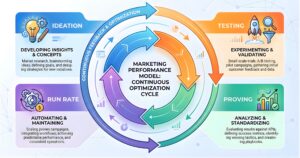
By following this model, we ensure that our clients only scale programs that are proven to work, protecting their budgets and maximizing their return on investment.
Analyzing Performance
Organizations often ask how we determine if a campaign is successful before revenue is even generated. We look at the precursors to marketing performance. If we are running a lead generation program for a Business-to-Business (B2B) firm, we monitor early indicators like open rates, bounce rates, and pages per visit.
If these metrics are healthy, but revenue is not yet flowing, it may simply be a result of a long sales cycle. However, if these early indicators are poor, it is a clear sign that one of the links in the Campaign Performance Chain—likely Creative or Distribution—needs to be refined. This data-driven approach allows us to be proactive rather than reactive, making adjustments based on facts rather than guesswork.
FAQ: Campaign Performance
What is the Marketing Performance Model?
It is a structured framework used to classify and manage campaigns based on their stage of development, moving them from initial ideas to repeatable, high-performing programs.
What are the phases a campaign goes through before scaling?
A campaign moves through Ideation (planning), Testing (validating assumptions), and Proving (optimizing for results) before reaching the Run Rate phase, where it is fully scaled.
How do you determine if a campaign is successful before looking at revenue?
We monitor “Earlier Indicators of Success,” such as Click-Through Rates (CTR), conversion rates, and the cost per lead. These metrics show whether the campaign is resonating with the audience and moving them toward the final goal.
What happens if a campaign isn’t generating conversions?
A lack of conversions usually indicates a problem in the previous links of the chain. We investigate whether the creative message is unclear or if the distribution is targeting the wrong audience segments.
How do you define “quality” in performance marketing?
Quality is defined by how well a conversion aligns with the ultimate goal of generating revenue. In a professional services or software context, a high-quality lead is one that fits the ideal customer profile and has a high likelihood of becoming a paying client.
Summary of Key Takeaways
The Campaign Performance Chain provides a clear roadmap for achieving measurable growth. By ensuring that Creative, Distribution, Conversion, and Pipeline links are all strong and properly aligned, Goose Digital helps businesses cut through the complexity of modern marketing. Whether through an “Extend” retainer that augments an existing team or a “Transform” project that builds a strategy from the ground up, our focus remains on delivering scalable, data-driven results that drive real business outcomes.
Actionable Tip: Review your current top-performing campaign and identify which of the four links (Creative, Distribution, Conversion, or Pipeline) has the lowest performance metric; focus your next two weeks of optimization exclusively on strengthening that single link.
Sources
HubSpot, “The State of Marketing 2024,” https://www.hubspot.com/state-of-marketing
Content Integrity
This article was generated with the assistance of AI and edited by a human team member.