
Audio Overview
For a Chief Marketing Officer at a mid-to-large manufacturing, energy services, or industrial firm in Edmonton or Calgary, the standard marketing playbook does not apply. We do not sell software subscriptions with a 14-day free trial. We sell multi-million dollar capital equipment, complex engineering services, and long-term contracts. Our sales cycles stretch from six to twenty-four months, and deals are closed by field sales teams who have historically relied on relationships, not digital campaigns.
Yet, the pressure from the board remains the same: Prove your pipeline contribution, lower the cost of acquisition, and modernize the revenue engine.
When B2B marketing leaders in Alberta evaluate their Customer Relationship Management (CRM) and marketing automation infrastructure, they are largely ignoring the flashy feature updates pitched by vendors. Instead, they are looking for practical solutions to deep operational bottlenecks.
If an industrial CMO were to write a completely unfiltered wishlist for their martech stack, here is exactly what it would look like.
1. An End to the “Franken-Stack” (And True ERP Integration)
The era of buying a new specialized SaaS tool for every micro-problem is over. Budgets are tightening, and tech bloat is a liability. An enterprise CMO doesn’t want to add another standalone platform; they want to consolidate operations within their core systems; whether that is Salesforce, HubSpot, or Microsoft Dynamics.
More importantly, the CRM and automation platforms must talk directly to the ERP (Enterprise Resource Planning) system. In manufacturing, you cannot accurately market to a customer if you don’t know their current supply chain status, their historical purchase volume, or their warranty expirations. The wishlist includes a bi-directional data flow where marketing automation can trigger campaigns based on actual production data and inventory levels, not just website clicks.

2. Attribution That Speaks the CFO’s Language
Industrial CMOs are tired of defending their existence using vanity metrics. Reporting on website traffic, email open rates, and even raw Marketing Qualified Leads (MQLs) holds zero weight in an executive boardroom.
The CRM must be architected for closed-loop, multi-touch attribution. The CMO needs to show the CFO a dashboard that tells a definitive financial story:
| The Legacy Metric | The CMO’s Required Metric | Why It Matters to the Board |
| Cost Per Lead (CPL) | Customer Acquisition Cost (CAC) | Proves the financial efficiency of the entire go-to-market motion, not just top-of-funnel marketing. |
| Total MQLs Generated | Marketing-Originated Pipeline | Shows exactly how many actual dollars in the sales pipeline were sourced by marketing campaigns. |
| Email Click-Through Rate | Pipeline Velocity | Measures how marketing automation is removing friction and shortening the 12-to-18-month industrial sales cycle. |
| Campaign ROI | CAC to LTV Ratio | Demonstrates that marketing is acquiring high-value, long-term contracts, not just one-off transactional buyers. |
3. ABM Orchestration for Complex Buying Committees
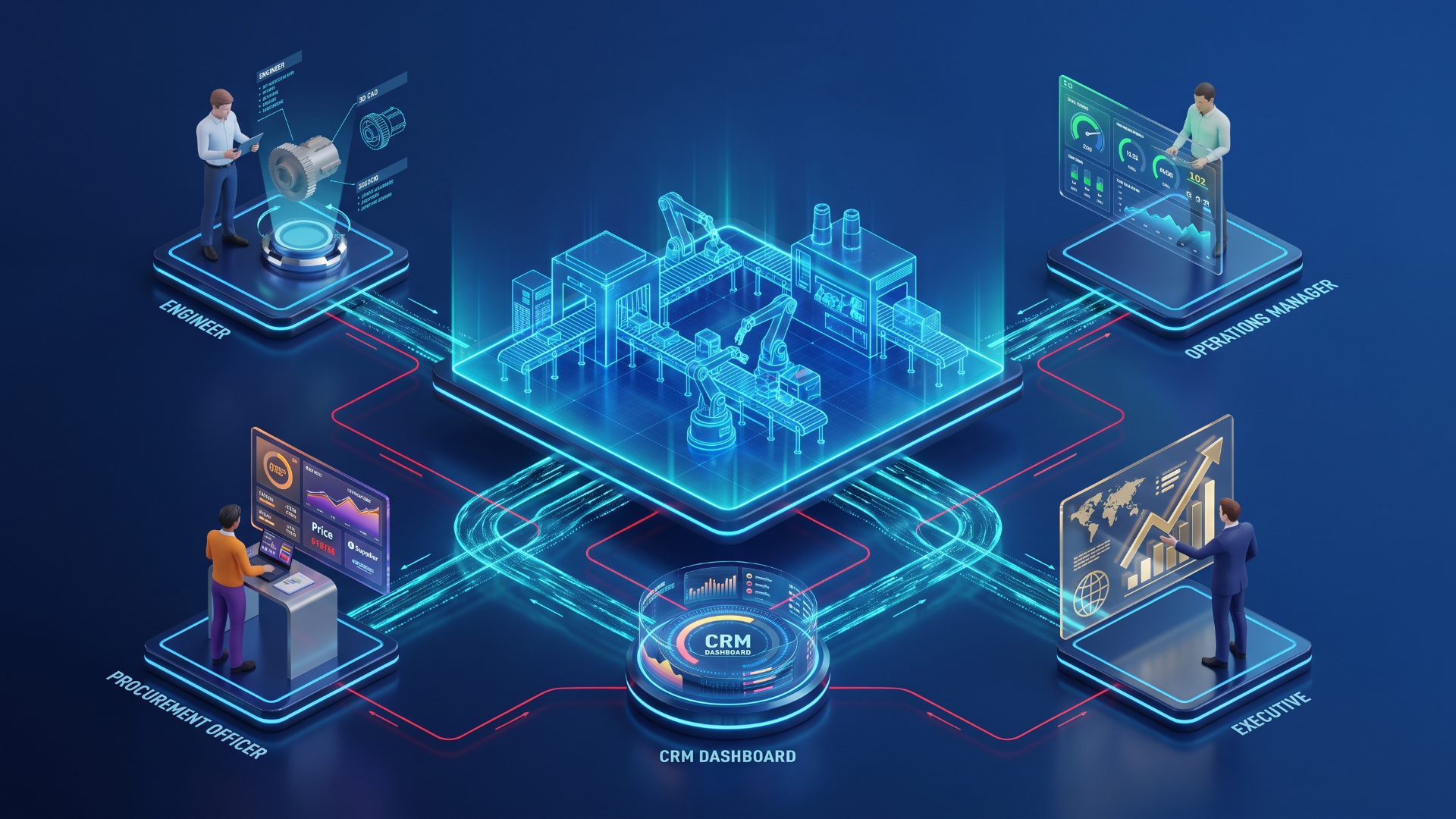
In heavy industry, you do not sell to an individual; you sell to a committee. A single deal requires buy-in from the lead engineer (evaluating technical specs), the operations manager (evaluating uptime), the procurement officer (evaluating cost), and the CEO (evaluating strategic fit).
Traditional marketing automation is built around the individual lead. The CMO’s wishlist demands a system built around Account-Based Marketing (ABM). The CRM must automatically associate all individual stakeholders with their parent account and track aggregate engagement. If an engineer downloads a CAD file, the procurement officer visits the pricing page, and the CEO reads a case study, the system must recognize that the account is showing high intent, score it accordingly, and alert the sales team to move.
4. Automation That Field Sales Actually Trusts
The tension between marketing and sales is notoriously high in traditional manufacturing. Field reps in Alberta often view the CRM as an administrative surveillance tool rather than a revenue enabler. If marketing hands over a lead that isn’t ready to buy, sales ignores the next ten.
The CMO wants a system that automates the handoff flawlessly and provides the sales team with actionable intelligence, not just contact info.
- Intent-Based Routing: The system shouldn’t just assign a lead; it should notify the rep why the lead is being assigned (e.g., “The VP of Operations at Account X just watched a 10-minute demo on the new compressor line”).
- Frictionless Data Entry: Automation should strip away the administrative burden for sales. Meeting summaries, email logging, and contact updates should happen in the background, allowing reps to spend their time on job sites and in boardrooms, not doing data entry in their trucks.
5. Pragmatic AI Built on Clean Data Architecture
While software vendors push generative AI for writing generic blog posts, the enterprise CMO is looking for AI that drives operational efficiency. However, AI is useless if it is trained on a decade of duplicate contacts, outdated accounts, and messy data.
PwC
The priority is utilizing AI for data governance first; automatically merging duplicates, enriching incomplete account profiles, and standardizing industry classifications. Once the data is clean, the CMO wants AI to surface predictive insights: analyzing historical CRM data to identify which accounts in the pipeline are most likely to stall, or flagging existing customers whose usage patterns suggest they are ripe for an equipment upgrade.
The Bottom Line
For mid-to-large companies navigating the complexities of the Alberta market, the technology itself is no longer the differentiator. The competitive advantage goes to the organization that can take their existing CRM and automation platforms and architect them into a unified, transparent, and frictionless revenue engine. The CMO doesn’t need more software; they need operational alignment.
Sources
Sources are not provided for this content, as it is based on widely accepted information.
Content Integrity
This article was generated with the assistance of AI and edited by a human team member.