
There are a lot of reasons an insurance organization might start thinking about changing its digital marketing, CRM, or marketing automation partner:
- Sometimes the relationship has simply run its course.
- Sometimes the technology is not delivering what was expected.
- Sometimes campaigns take too long to get into market.
- Sometimes reporting looks impressive, but it is difficult to connect any of it back to actual business results.
- And sometimes the internal marketing team realizes they are spending a surprising amount of time helping their external partner understand the nuances of insurance.
Over the years, we have worked alongside insurance organizations at very different stages of their digital journey—from smaller independent brokerages and MGAs to large national and global organizations. Goose’s Insurance practice spans carriers, brokers, and MGAs, bringing together in-house insurance expertise with modern digital marketing and execution.
That experience has taught us something fairly simple: The best marketing and technology partnerships in insurance are rarely about having the most tools, the biggest agency, or the newest platform. They are about understanding the business well enough to know what actually needs to be done—and how to execute it.
What should an insurance company look for in a digital marketing or MarTech partner?
At a high level, insurance organizations should look for a partner that understands insurance distribution, buying cycles, broker and customer journeys, marketing technology, data, and tangible business outcomes.
The strongest partnerships tend to combine industry knowledge with broad capabilities across areas such as digital marketing, CRM, marketing automation, content, paid media, SEO, AEO, analytics, and measurement.
But perhaps most importantly, the partner needs to understand the business well enough to create marketing that is actually relevant—which is critical in today’s AI landscape.
Good insurance marketing is not just about knowing how to operate the technology. It is about understanding who you are talking to, what matters to them, where they are in the buying journey, and what story needs to be told at that exact moment.
Why does insurance industry experience matter in marketing?
Insurance is not an industry you completely understand after a few discovery meetings. There are layers to it:
- Distribution matters.
- Appetite matters.
- Underwriting matters.
- Relationships matter.
- Compliance matters.
- Unique buying patterns and cycles matter.
Depending on the organization, the person you are marketing to may not even be the person ultimately purchasing the insurance:
- Carriers may need to engage brokers while simultaneously building demand with insureds.
- MGAs may be trying to educate brokers about appetite while helping those brokers identify opportunities within their existing books.
- Brokerages may have dozens of product lines, offices, and producers, each serving very different types of customers across different regions.
And that is before you factor in policy systems, broker management systems (BMS), CRMs, marketing automation, portals, rating technology, and data platforms sitting behind the customer experience.
This is why industry experience matters. Not because an agency needs to know every insurance detail on day one, but because there is a very real difference between learning your specific insurance business and learning insurance itself.
Your partner should absolutely have to learn your organization: your products, culture, distribution strategy, appetite, growth goals, and customers. However, good marketing requires telling the right story to the right audience at the right time in a way that resonates. In insurance, that messaging must reflect real buying cycles, customer concerns, current broker pressures, and the emotional weight behind coverage decisions.
Relevance matters—and relevance is very hard to manufacture from the outside.
How does industry knowledge affect time to market?
This issue does not get talked about enough. Marketing teams are busy. When an outside partner does not understand the industry, someone internally has to fill that gap.
That means:
- Explaining basic industry terminology
- Rewriting campaign content
- Correcting audience targeting
- Providing technical product context
- Explaining why one lead is substantially more valuable than another
- Walking through complex distribution relationships
- Explaining why a campaign that looks successful in Google Analytics isn’t actually producing profitable written business
None of these things are catastrophic on their own, but together they create friction—and friction directly impacts time to market. A campaign that should take three weeks takes six. A piece of content goes through five rounds of revisions. An automation journey is technically sound, but fails to reflect the actual interplay between a broker, underwriter, and insured.
The goal of a strong external partner should be to give an internal marketing team more capacity, not create another layer for that team to manage.
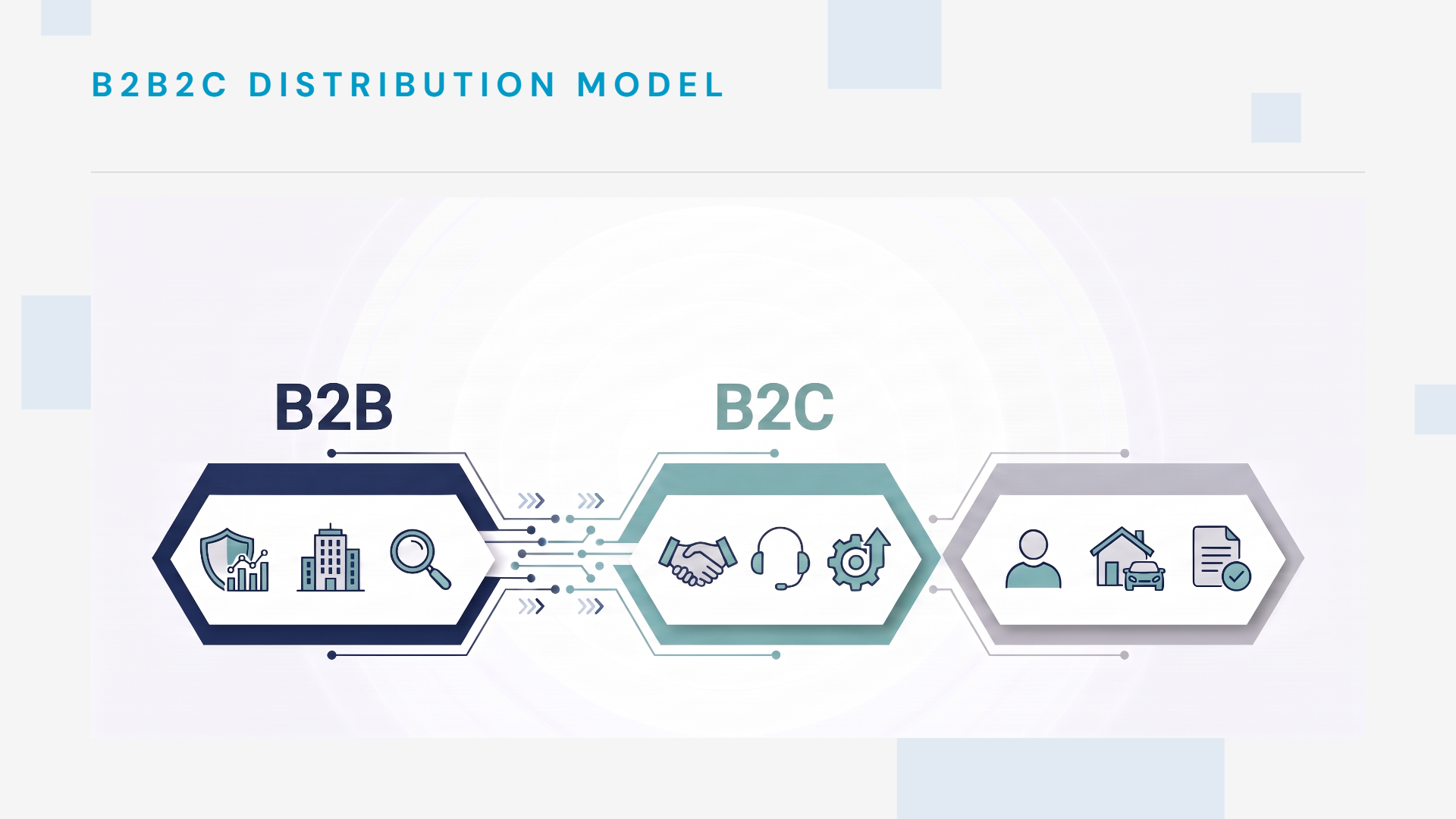
Why is B2B2C so important in insurance marketing?
A lot of insurance marketing does not fit neatly into a B2B or B2C box—it sits right in between.
A carrier may need a broker to understand and recommend a product before the end customer ever sees it.
- An MGA may need to influence both the broker and the insured simultaneously.
- An affinity program may involve an association, an insurer, an advisor, and an individual member.
- Different product lines within the same organization often require completely different paths to market.
This means customer journey mapping in insurance needs to go deeper than identifying the end user. We often ask:
- Who actually creates the opportunity?
- Who influences the decision?
- Who needs to understand the product?
- Who submits the business?
- Who owns the relationship long-term?
- Who needs to hear from us before there is even an active buying opportunity?
- These nuances affect everything from content strategy and paid media to CRM architecture and marketing automation. They are precisely why generic digital marketing playbooks fail to translate into insurance results.
How should marketing automation support the insurance business?
The insurance industry has invested heavily in technology over the past decade: CRM platforms, updated BMS systems, Marketing Automation, broker portals, online quoting, digital applications, data platforms, and now AI.
Implementing technology and actually extracting business value from it are two very different things:
- A marketing automation platform can send millions of emails, but that does not equal a strategic broker engagement model.
- A CRM can store endless data, but that does not mean the team knows which data points drive revenue.
- An AI tool can generate content quickly, but that content isn’t automatically useful, accurate, or differentiated.
Technology must solve real operational problems. For insurance organizations, that includes:
- Helping brokers better understand appetite and target risks
- Streamlining broker onboarding for new digital tools
- Re-engaging quoted-not-bound prospects
- Supporting policy renewal and retention workflows
- Identifying cross-sell opportunities within existing books
- Improving lead routing and producer prioritization
- Recovering abandoned digital quotes
- Bridging communication between sales and underwriting triage
- Connecting marketing activity directly to written business
Should you replace your CRM or marketing automation platform?
Sometimes—but not always. There is no single platform that is right for every insurance organization.
While a new CRM or Marketing Automation tool is occasionally necessary, the root issue is often data structure, user adoption, strategy, or underutilized capabilities in a platform implemented years ago.
This is why platform independence matters. A technology evaluation should always start with:
“What business outcomes are we trying to accomplish?”
Not: “How do we migrate you onto our preferred platform?”
There are many capable platforms available, including Salesforce, HubSpot, Act-On, Microsoft Dynamics, and others. The best fit is the technology that aligns with your organization’s specific functional requirements, existing stack, internal capabilities, and long-term strategy.
Occasionally, the best recommendation is simply: “Keep what you have and optimize it.” There is real value in a partner willing to say that.
What should insurance marketing reporting actually measure?
Top-of-funnel metrics still matter. Traffic, search visibility, email open rates, and lead counts provide initial context. However, as insurance marketing matures, reporting must track outcomes further downstream:
[ Impressions & Clicks ] ──► [ Qualified Leads ] ──► [ Quotes & Submissions ] ──► [ Bound Policies & Written Premium ]
- Did the lead request a quote?
- Was the risk eligible for your appetite?
- Did the broker submit the business?
- Did the policy bind?
- What was the total written premium, and with which market?
- Was the written business profitable?
- Did the client renew at year one?
Connecting data across legacy insurance systems is difficult, and very few organizations accomplish total attribution overnight. But marketing measurement should continually move closer to the metrics leadership cares about:
- Qualified leads & submissions
- Quote-to-bind ratios
- Total written premium & carrier placement
- Retention rates & cross-sell metrics
- Customer lifetime value (LTV)
How are SEO, AEO, and AI changing insurance marketing?
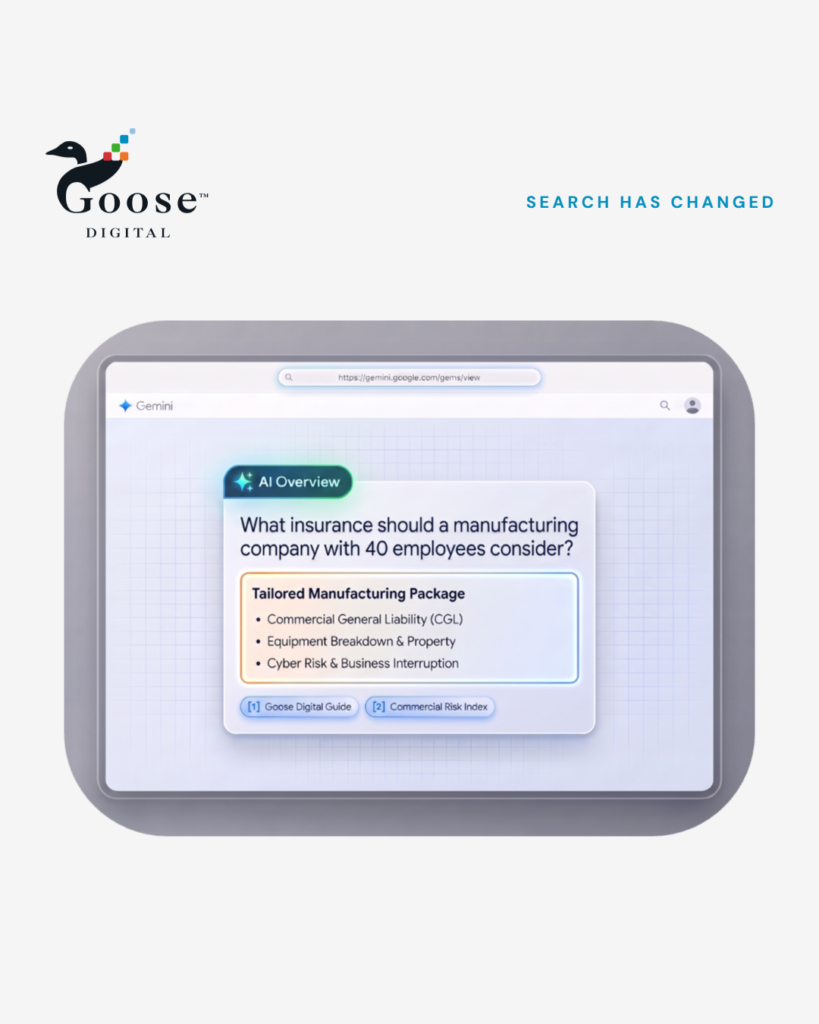
Search is experiencing a fundamental shift. Traditional SEO and Google rankings still matter, but buyers and brokers are increasingly obtaining direct answers from AI answer engines (AEO).
Treating AI search as an entirely new discipline is a mistake. Strong Answer Engine Optimization (AEO) still relies on foundational content principles:
- Clear, structured information
- Solid website architecture and technical SEO
- Authoritative, expert-backed answers
- Deep alignment with user intent
For insurance, AI tools can accelerate content creation, but the true advantage occurs when AI is combined with human subject-matter expertise. You still need specialists who understand broker appetite, regulatory nuances, and complex coverage products.
This human-in-the-loop model allows organizations to scale content production faster without compromising accuracy, brand trust, or compliance.
What does digital transformation actually mean for an insurance organization?
There is no single “digital transformation” blueprint for insurance:
- Some organizations feature end-to-end automation; others rely on relationship-driven, manual workflows.
- Some invest heavily in direct-to-consumer (DTC) portals; others remain strictly broker-first.
- Some maintain large internal marketing teams needing hyper-specialized execution; others require an agency to operate as a full extension of their department.
Digital transformation should never be about accumulating software. It must deliver tangible operational improvements:
- Faster execution and reduced time to market
- Frictionless customer and broker experiences
- Higher policy retention and lifetime value
- Measurable, profitable premium growth
8 Questions to ask before choosing your next marketing partner
If you are evaluating new digital marketing, CRM, or MarTech partners, ask these questions during discovery:
- How much will we have to teach you about insurance?
Determine how much foundational education your team will be forced to provide.
- How do you define a successful insurance marketing program?
Listen for whether they stop at clicks/leads or focus on submissions, bound policies, and written premium.
- How do you approach our existing technology stack?
Be cautious if replacing your CRM or automation tool is their immediate recommendation before discovery.
- How do you approach broker vs. end-customer journeys?
Reveals whether they truly understand multi-tier B2B2C distribution.
- How will your team integrate with our internal resources?
The goal should be building internal capacity, not adding management overhead.
- How do you handle insurance data and attribution?
Ensure they understand why connecting campaign data to BMS/policy records matters.
- What is your pragmatic view on AI in insurance marketing?
Look for balanced answers that prioritize accuracy, domain expertise, and realistic use cases.
- Do they understand our primary business objective?
Technical skill matters, but strategic alignment and cultural fit determine long-term success.
Finding the Right Fit
There is no single “perfect” agency model in insurance. Every organization operates with distinct technology, distribution channels, target risks, and internal skill sets.
However, high-performing partnerships share common traits:
- Deep mutual trust
- Shared industry domain knowledge that skips the learning curve
- Technology treated as an enabler rather than the strategy itself
- Shared accountability for actual business outcomes
The value of an experienced partner isn’t having every answer upfront—it is understanding the insurance business well enough to ask better questions, challenge assumptions, and execute strategies that drive sustainable growth.
About the Author
Jennifer Pugsley
VP Customer Success, Goose Digital
Jennifer has spent over 20 years at the intersection of insurance and digital marketing. She works alongside carriers, MGAs, and brokerages to scale digital marketing initiatives, optimize CRM and marketing automation platforms, and navigate the evolving role of AI and modern search in insurance.
Sources
Sources are not provided for this content, as it is based on widely accepted information.
Content Integrity
This article was generated with the assistance of AI and edited by a human team member.