

Audio Overview
A warehouse manager for a distributor stares at a familiar report. A specific line of industrial components, purchased in anticipation of a project that was later scaled back, has been sitting on the shelves for over 90 days. This slow-moving inventory ties up capital and occupies valuable space. The manager knows the next steps: draft an email to the sales team, coordinate with marketing to create a promotional one-sheeter, and then manually follow up to see if anyone has had success offloading the stock. The entire process is reactive, time-consuming, and pulls a team of skilled people away from focusing on new growth opportunities. What if the system that identified the problem could also be the one to solve it, all on its own?
The Data Dilemma: When Insight Isn’t Enough
In today’s manufacturing and distribution sectors, data is everywhere. It flows from Enterprise Resource Planning (ERP) systems tracking inventory, Customer Relationship Management (CRM) platforms managing sales pipelines, and e-commerce sites processing orders. The challenge is no longer about gathering information; it’s about converting that information into timely, profitable action. According to a recent survey by PwC, 52% of manufacturing CEOs expect generative artificial intelligence (AI) to significantly change how their companies create and deliver value in the near future [1].
Traditional analytics dashboards are excellent at highlighting what has already happened. They can tell you which products are underperforming, which sales regions are lagging, or which customers haven’t ordered in a while. But this is where their contribution ends. They present an insight and place the burden of developing and executing a solution squarely on the shoulders of your team.
This gap between insight and action is where opportunities are lost. While your team is busy coordinating a manual response to a problem, competitors are moving faster, customers are looking elsewhere, and market conditions are changing. The competitive advantage in manufacturing is no longer defined by who has the most data, but by who can act on it the fastest.
Defining the AI Agent: Your Autonomous Problem-Solver
This is where a new evolution of artificial intelligence comes into play: the AI Agent.
An AI Agent is not just a dashboard or a chatbot. It is an autonomous system designed to perceive its digital environment, make decisions based on a defined goal, and take tangible actions to achieve that goal.
Think of it as a dedicated digital employee who works 24/7 to solve specific business problems. Where traditional analytics stops at providing information, an AI Agent takes the next crucial steps.
- Traditional Analytics: “You have 1,000 units of Product #ABC-123 that has been in stock for over 90 days, representing $50,000 in tied-up capital.”
- The AI Agent: “I have detected 1,000 units of slow-moving inventory for Product #ABC-123. Based on our goals to clear excess stock, I will now:
- Access the CRM to identify a list of 50 customers who have purchased this product or similar items in the past 18 months.
- Use generative AI to draft a personalized promotional email offering a 10% discount on orders of 100 units or more, valid for the next two weeks.
- Launch this email campaign through our marketing automation platform.
- Monitor the results and provide a summary report on sales generated from this action by the end of the month.”
The AI Agent doesn’t just report the problem; it executes the solution, turning a potential loss into a revenue opportunity while your team remains focused on higher-value strategic tasks.
Practical Applications in Manufacturing and Distribution
The concept of an AI Agent moves from theory to reality when applied to the everyday challenges of manufacturers and their distribution partners. By integrating with core business systems like your CRM, Marketing Automation Platform (MAP), and e-commerce channels, these agents can drive efficiency and growth at scale.
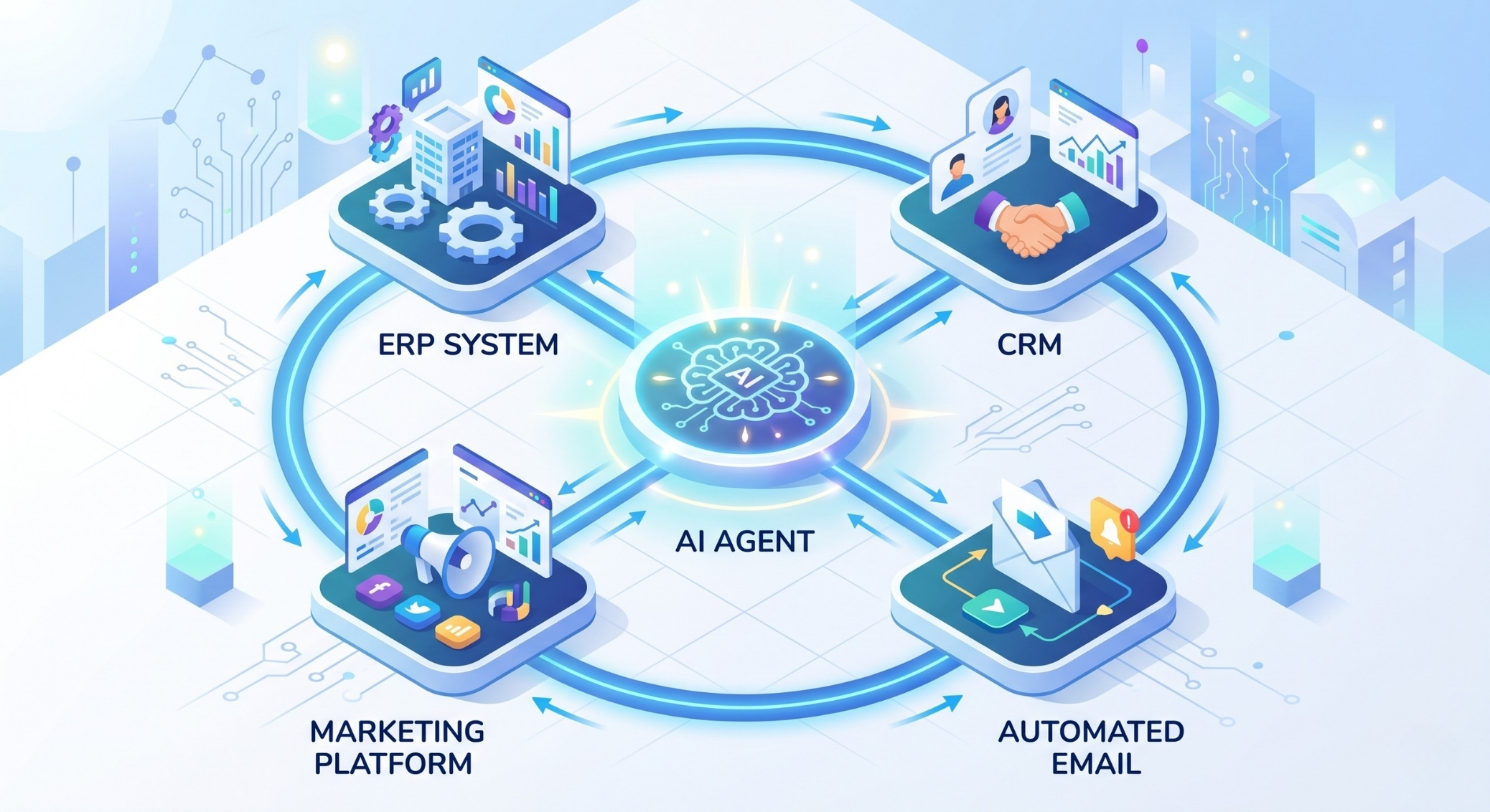
- Clearing Excess Inventory Automatically: Expanding on our initial scenario, an AI Agent programmed to manage inventory levels can execute a complete, end-to-end campaign. It connects ERP data with CRM and marketing platforms like Salesforce Marketing Cloud, Pardot, or HubSpot to run a promotion without human intervention. The rules are set in advance, but the execution is entirely autonomous, ensuring that inventory issues are addressed the moment they arise, not weeks later when someone gets around to reviewing a report.
- Scaling E-commerce and Channel Sales: For distributors with an e-commerce presence on platforms like Shopify or WooCommerce, an AI Agent can act as a tireless sales assistant. It can monitor for abandoned shopping carts containing high-margin products and automatically trigger a follow-up sequence. This could include an email with a reminder, a link to a helpful technical specifications sheet, or even a time-sensitive shipping offer to encourage conversion.
- Enhancing Customer and Prospect Communications: An AI Agent can monitor customer purchase history to identify changes in buying patterns. If a key account that typically orders every 60 days goes to day 75 without a new purchase order, the agent can automatically alert the designated account manager. It can even pre-draft a personalized check-in email, allowing the sales representative to simply review and send, strengthening the relationship and preventing customer churn.
- Streamlining Revenue Operations: Connecting sales and marketing data is a common hurdle. An AI Agent can help align these functions by managing the lead lifecycle. For instance, when a new lead is generated from a paid advertising campaign, the agent can instantly enrich the data, score the lead based on pre-set criteria, assign it to the correct sales representative in the CRM, and schedule a follow-up task. This ensures no lead is left behind and that the sales team always engages with the highest-potential prospects first.
The Goose Digital Advantage
The power of an AI Agent lies in its ability to connect disparate systems and act on data autonomously. However, this is only possible when a solid operational foundation is in place. The data from your CRM, ERP, and marketing platforms must be clean, integrated, and accessible.
This is where Goose Digital’s Intelligent Marketing approach creates a distinct advantage. We bring together the right platforms, processes, and people to build the infrastructure needed for advanced automation and AI. Our expertise across marketing operations, CRM integration (including Salesforce, Microsoft Dynamics, and HubSpot), and revenue strategy ensures your technology stack is ready to support these powerful new tools. We don’t just talk about the potential of AI; we build the practical, integrated systems that turn that potential into measurable business outcomes. By bridging the gap between insight and action, we help manufacturers and distributors transform their data from a passive resource into their most powerful driver of growth.
Ready to learn how we can help you achieve your goals?
Click here to start the conversation with the Goose Digital team.
Sources
[1] PwC, “27th Annual Global CEO Survey,” 2024. https://www.pwc.com/gx/en/ceo-survey/2024/download/27th-ceo-survey.pdf
Content Integrity
This article was generated with the assistance of AI and edited by a human team member.