
How can manufacturing and distribution leaders build a more efficient, profitable future when the path forward seems cluttered with complex technology and competing priorities?
For many businesses in these foundational sectors, the pressure to innovate is immense. The goal is to do more with less; increase the quality and quantity of marketing, streamline operations, and drive growth, all while managing tight budgets. The rise of automation and artificial intelligence (AI) promises a solution, but adopting these tools can feel like an overwhelming task.
The good news is that the journey toward a more efficient operation doesn’t require a complete and immediate overhaul. It begins with a clear, actionable roadmap. By embracing an Intelligent Marketing approach, one that blends strategy, automation, AI, and human creativity; organizations can build a scalable foundation for growth, one focused step at a time. This article provides that roadmap.
The Critical Shift: From Collecting Data to Acting on It
The competitive gap in today’s industrial landscape isn’t defined by who has the most data, but by who can act on it the fastest and most effectively. For years, businesses have focused on collecting information from their Customer Relationship Management (CRM) platforms, Enterprise Resource Planning (ERP) systems, and website analytics. This data is valuable, but it often only tells you that a problem exists.
This is where the new generation of AI changes the game.
- Traditional Analytics might show a decline in leads from a key distributor channel.
- Intelligent, Agentic AI can go a step further. It can identify the drop, analyze potential causes (like a competitor’s campaign or a change in search trends), and automatically trigger a solution; such as launching a targeted re-engagement campaign for that distributor’s audience or alerting the sales team with specific talking points.
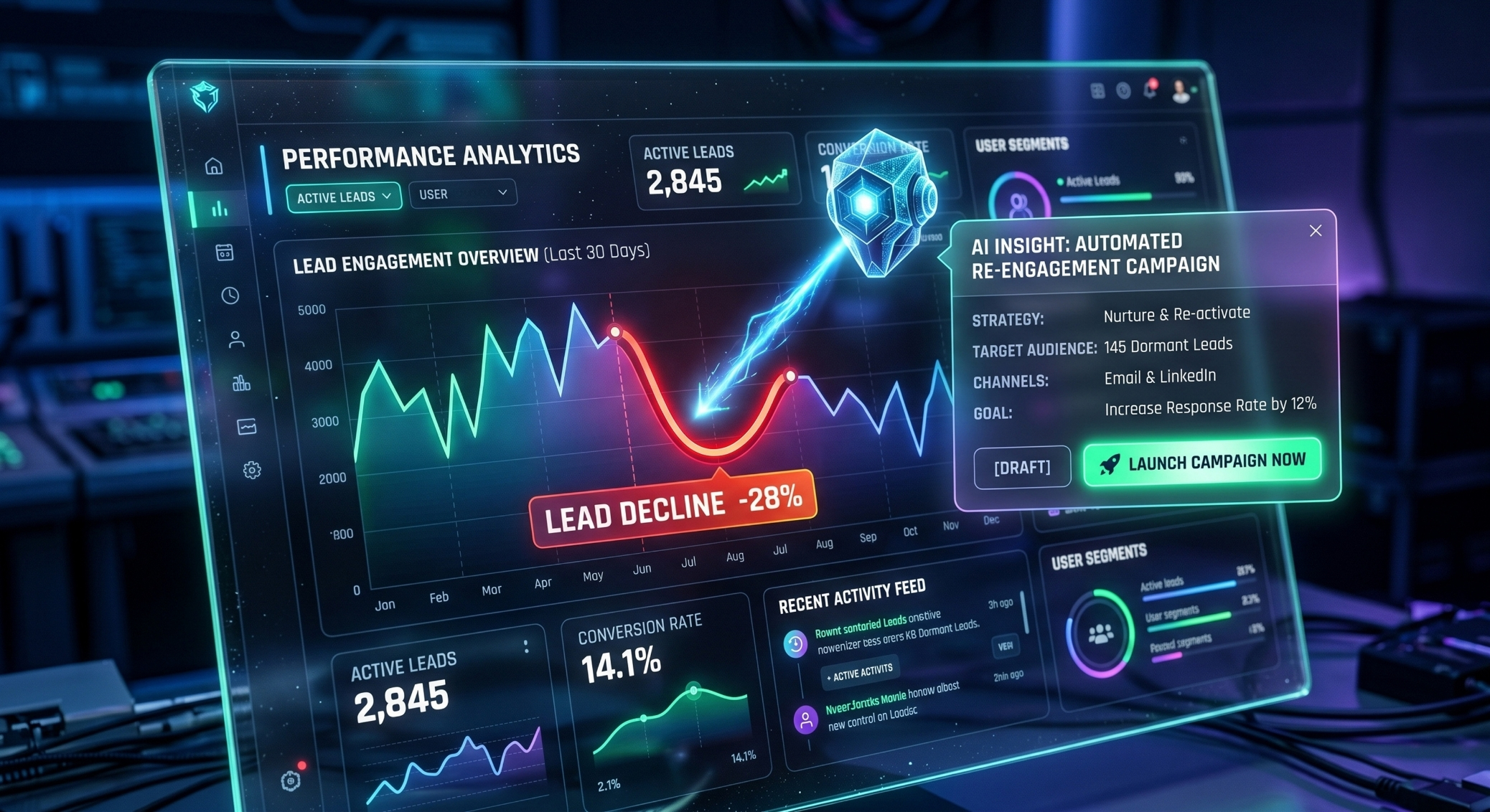
This shift from passive insight to active problem-solving is at the heart of Intelligent Marketing. It allows your team to focus on high-value strategic work while technology handles the routine, data-driven tasks that accelerate growth.
Phase 1: The Foundational Audit (Know Where You Stand)
Before you can build a new system, you must understand the one you currently have. A foundational audit is the essential first step to identify opportunities for improvement and avoid costly missteps.
Conducting a Technology and Process Audit Start by mapping out your current state. Ask critical questions about your key systems and the processes that connect them:
- Data Hubs: What CRM and ERP systems are in use? Is the data within them clean and accessible?
- Marketing & Sales Flow: How are leads currently generated, tracked, and passed to the sales team or distributor network? Where do manual handoffs create delays?
- Customer Communication: How do you communicate with existing customers for renewals, cross-selling, or service updates? Are these processes manual or automated?
Identifying Integration Bottlenecks
For many manufacturers and distributors, the biggest challenge is siloed data. Sales information lives in the CRM, inventory and order details are in the ERP, and customer service tickets exist in a separate platform. This separation prevents a unified view of the customer, making it impossible to automate intelligently. Identifying these bottlenecks is crucial for creating a system where data flows freely, enabling smarter marketing and sales actions.
Phase 2: Charting the Course (Build Your Roadmap)
With a clear picture of your current state, the next phase is to define where you want to go. This isn’t about chasing the latest AI trend; it’s about tying technology directly to measurable business outcomes.
Defining Clear Business Objectives
Instead of a vague goal like “we need to adopt AI,” focus on specific, tangible objectives. For example:
- “We need to reduce the time it takes to qualify and route a new lead to the correct distributor by 50%.”
- “We need to increase repeat orders from our top 20% of customers by 15%.”
- “We need to automate our renewal reminder process to improve on-time renewals by 25%.”
These goals provide clear targets and make it easier to measure the return on your investment.
Uncovering High-Impact Opportunities
Once objectives are set, you can identify where technology can make the biggest difference. This is a critical strategic step where expert guidance can help prioritize efforts and ensure alignment across departments. For example, Goose Digital provides an AI Roadmapping and Readiness service which helps business leaders and stakeholders unpack where AI can have the biggest impact in their business. This collaborative process moves beyond theory and outlines a practical, phased approach tailored to your specific operational realities, focusing on high-impact areas like automating quote follow-ups or personalizing marketing content based on a customer’s past purchase history.
Phase 3: The Pilot Project (Start Small to Prove Value)
Rather than attempting a massive, company-wide implementation, a focused pilot project is the most effective way to start. It allows you to test a new process, prove its value with measurable results, and build momentum for broader adoption.
Choosing the Right Pilot
A strong pilot project should be:
- Measurable: Its success or failure can be clearly tracked with data.
- Targeted: It addresses a specific, well-understood pain point.
- Contained: It involves a small, motivated group and won’t disrupt the entire organization if adjustments are needed.
Pilot Project Examples for Manufacturers and Distributors:
- Automated Lead Nurturing: Create a simple, automated email sequence for new inquiries. When someone downloads a product spec sheet, the system automatically sends a series of follow-up emails with related case studies, technical information, and an invitation to speak with a specialist.
- Scaling E-commerce Channels: Use an AI-powered tool to generate consistent, search-optimized product descriptions for an online parts catalog, freeing up marketing staff for more strategic tasks.
- Intelligent Sales Alerts: Set up a workflow that automatically notifies a sales representative via their CRM when a contact from one of their key accounts visits the pricing page on your website. This provides a timely and relevant reason to reach out.
Phase 4: Scaling for Growth (From Pilot to Program)
A successful pilot provides the proof and the blueprint needed for expansion. The insights gained; what worked, what didn’t, and what data was most valuable; inform a wider rollout.
This phase is about turning a successful experiment into a core business process. It involves refining the technology stack, ensuring data hygiene, and training teams to leverage the new capabilities. It is an ongoing cycle of implementation, measurement, and optimization that builds upon initial successes to create lasting, compounding value for the organization.
The Goose Digital Advantage
Our Advantage lies in our Intelligent Marketing approach, which transforms complexity into a clear, actionable strategy. We don’t just recommend technology; we integrate it into your operations, aligning platforms, processes, and people to drive measurable revenue growth. By partnering with Goose Digital, manufacturing and distribution leaders gain more than a service provider; they gain an extension of their team, dedicated to building a scalable, efficient, and profitable future.
Ready to scale your business and build your Intelligent Marketing Roadmap? Contact Goose Digital today to get started.
Sources
Sources are not provided for this content, as it is based on widely accepted information.
Content Integrity
This article was generated with the assistance of AI and edited by a human team member.