

Imagine sitting in an executive board meeting as a mid-market VP of Marketing. The CFO looks over her glasses, points to a multi-million-dollar line item, and asks a straightforward question: “Which specific campaigns brought in our top five revenue-generating deals this quarter?”
You pause. You know the marketing team pulled off a stellar LinkedIn campaign, hosted a packed webinar series, and overhauled organic SEO. The pipeline is healthy, and revenue is up. Yet, looking at your default CRM reports, the data credits 100% of those million-dollar conversions to a single direct-traffic website visit or a random Google ad click right before purchase. The reality, that the customer engaged with 14 distinct touchpoints over six months before buying, is completely invisible.
You aren’t alone in this tension. Over 90% of marketers agree that attribution is critical to success, yet fewer than one-third feel confident in their ability to measure it. The good news? You don’t need a team of elite data scientists or an enterprise-grade analytics budget to fix this.
Practical Attribution Models for Mid-Market Organizations
Marketing attribution assigns credit to the various touchpoints a customer encounters on their journey to conversion. For mid-market organizations, selecting the right model means balancing accuracy with practicality—often leveraging existing Customer Relationship Management (CRM) and Marketing Automation Platform (MAP) capabilities.
Single-Touch Attribution Models
Single-touch models are the simplest to implement as they assign 100% of the credit to a single interaction. They are often the default in many platforms and can serve as an accessible starting point.
- First-Touch Attribution: This model credits the very first interaction a potential customer has with your brand. It is useful for understanding initial awareness and demand generation efforts. For example, if a prospect first discovers your company through an organic blog post, that post gets full credit for the conversion. This model is straightforward to implement within most systems by tracking the original lead source.
- Last-Touch Attribution: This model gives all credit to the final interaction before a conversion. It is particularly valuable for optimizing bottom-of-funnel activities, such as direct paid search campaigns or specific sales-focused calls to action. Many ad platforms default to last-touch reporting.
While easy to set up, single-touch models offer an incomplete picture, considering the modern B2B customer interacts with a dozen or more touchpoints before converting.
Multi-Touch Attribution Models
Multi-touch models distribute credit across multiple interactions, providing a more holistic view of the customer journey. These models offer deeper insights without requiring heavy data science infrastructure, especially when leveraging built-in features of modern technology platforms.
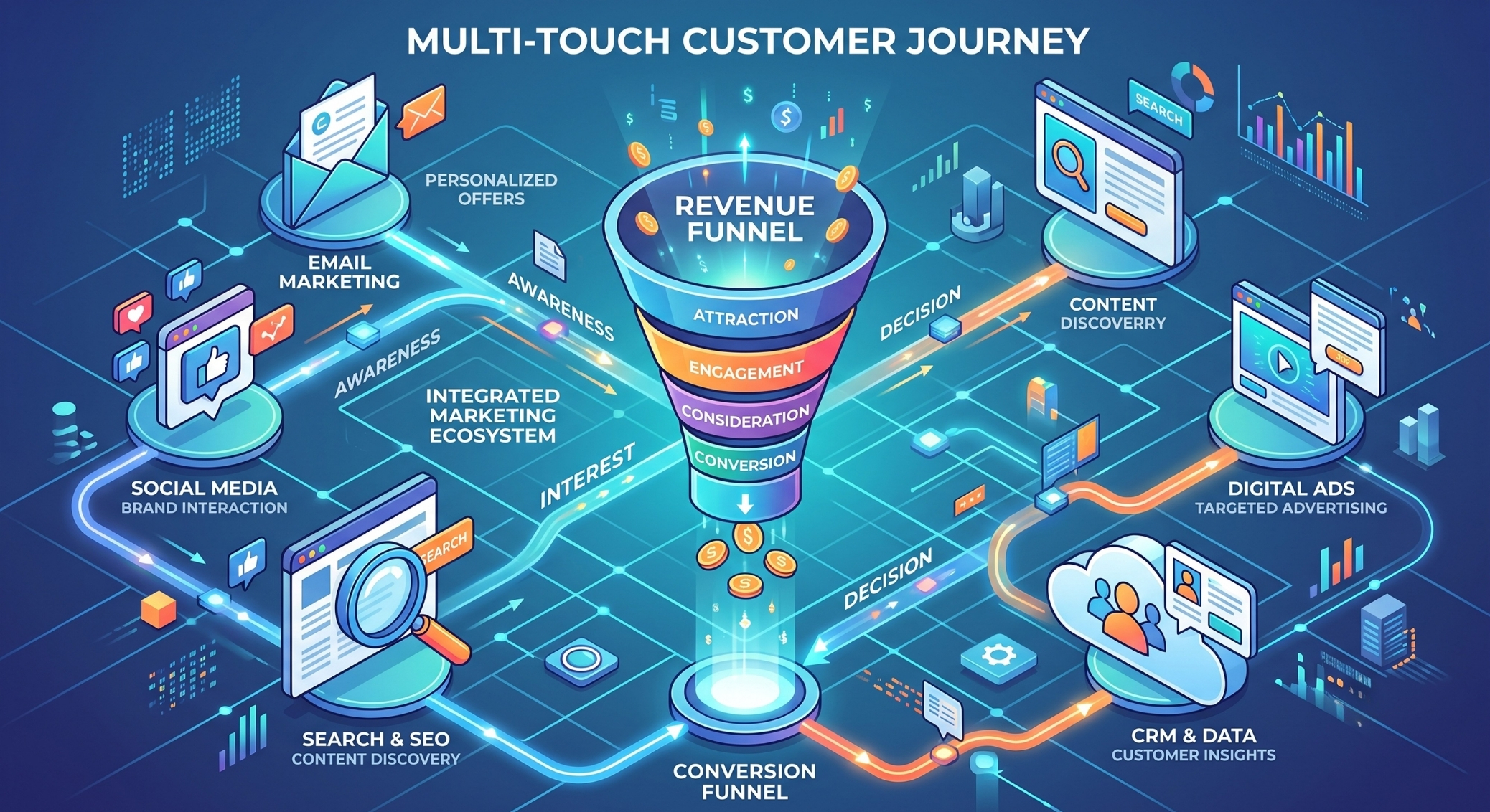
- Linear Attribution: Distributes credit equally among all touchpoints in the customer journey. If a customer interacts with five marketing touchpoints before converting, each receives 20% of the credit. It provides a fair, if simplistic, view of all contributing channels.
- Time Decay Attribution: Assigns more credit to touchpoints that occurred closer in time to the conversion, with diminishing credit for earlier interactions. It acknowledges that recent engagements often exert a stronger push toward a final decision.
- U-Shaped Attribution (Position-Based): Assigns 40% of the credit to both the first and last touchpoints, with the remaining 20% distributed evenly among middle interactions. This highlights the importance of both initial brand awareness and the final conversion driver; making it popular in B2B settings.
- W-Shaped Attribution: Assigns 30% of the credit to the first touch, the lead conversion touch (e.g., demo request), and the opportunity creation touch. The remaining 10% is distributed across supporting interactions. This model excels for teams with structured sales funnels and key milestone conversions.
Connecting Touchpoints to Revenue Outcomes with KPI Trees
To make attribution actionable, marketing leaders need to connect channel performance to broader business outcomes using a Key Performance Indicator (KPI) tree framework. Mapping these connections clarifies how early-stage activities directly impact downstream revenue.
- Awareness Stage: Focuses on paid media, inbound content, and display advertising. Key metrics include impressions, reach, and website traffic. The primary business impact is increasing brand visibility and top-of-funnel engagement.
- Engagement Stage: Driven by email nurturing, downloadable content, and webinars. Key metrics include click-through rates, form fills, and time spent on site. The primary impact is qualifying interest and gathering intent signals to move prospects forward.
- Demand Generation Stage: Focuses on gated assets, demo requests, and targeted events to generate Marketing Qualified Leads (MQLs). Key metrics include MQL volume and conversion velocity. The impact is providing a consistent flow of qualified leads to the sales team.
- Pipeline and Revenue Stage: Supported by account-based marketing (ABM) and sales enablement. Key metrics include marketing-sourced pipeline, SQL conversion rates, win rates, and marketing ROI. The ultimate impact is direct contribution to closed-won revenue and increased customer lifetime value.
Making ROI Visible Within Existing MarTech
You do not always need shiny new software to build a functioning attribution model. Core platforms like Salesforce, HubSpot, Microsoft Dynamics, and Pardot are designed to capture touchpoints effectively if configured properly.
- Consistent Campaign Tracking: The foundation of clear attribution is disciplined tracking. Standardize naming conventions and enforce campaign taxonomy across every email, ad, and asset.
- CRM Integration & Workflows: Ensure seamless synchronization between your marketing automation tool and CRM. Passing touchpoint data directly enables sales reps to see the buyer journey while giving marketing clear visibility into downstream revenue.
- Custom Reports & Dashboards: Utilize native reporting features to contrast channels. Building side-by-side comparisons of paid media ROI versus organic search directly inside your primary CRM keeps the data grounded in reality.
- Funnel Optimization: Attribution data highlights bottlenecks. If a channel yields high initial engagement but drops off before conversion, you know precisely where to tweak your nurturing process.
How Artificial Intelligence Enhances Measurement
Intelligent Marketing integrates strategy, technology, and AI to scale capabilities without bloating overhead. AI acts as an accelerator for data-driven mid-market teams:
- Automated Taxonomy Enforcement: AI tools can scan, detect, and fix inconsistent campaign tags before they skew your reporting metrics.
- Anomaly Detection: Machine learning algorithms continuously monitor conversion rates across stages, flagging unexpected drops (like a broken form) or performance spikes instantly.
- Executive-Ready Insights: AI can synthesize raw multi-channel data into clear, strategic narratives that explain why campaigns succeeded and what steps to take next.
AI should enhance strategic human decision-making, not replace it. Leadership remains in charge of defining objectives, while AI speeds up analysis and data handling.
What to Report to Executive Leadership
When presenting to executive leadership, strip away fluff and vanity metrics. Focus on a practical performance scorecard built around key financial and operational metrics:
- Marketing Sourced Pipeline: The total monetary value of the sales pipeline generated directly from marketing initiatives.
- Marketing Influenced Pipeline: The total deal value touched, nurtured, or accelerated by marketing efforts at any point along the journey.
- Marketing ROI: A direct calculation showing net revenue generated relative to total marketing expenditure.
- Customer Acquisition Cost (CAC): The average marketing and sales investment required to acquire a single new paying customer, broken down by primary channels.
- Pipeline Velocity: The speed at which qualified opportunities move through each stage of the funnel toward closed-won status.
Key Takeaways
Effective attribution in the mid-market isn’t about deploying overly complex data systems—it’s about matching practical frameworks to existing tech. Moving beyond single-touch views, structuring clear KPI trees, and utilizing AI automation allows marketing leaders to justify budgets, optimize tactics, and confidently demonstrate revenue impact.
Ready to transform your marketing measurement? Goose Digital partners with mid-market organizations to implement Intelligent Marketing Solutions that maximize ROI and drive scalable revenue growth. Contact us today to elevate your marketing operations.
Sources
Sources are not provided for this content, as it is based on widely accepted information.
Content Integrity
This article was generated with the assistance of AI and edited by a human team member.